Thursday, June 15, 2017

Jessica Chastain Marries In Italy Wearing McQueen

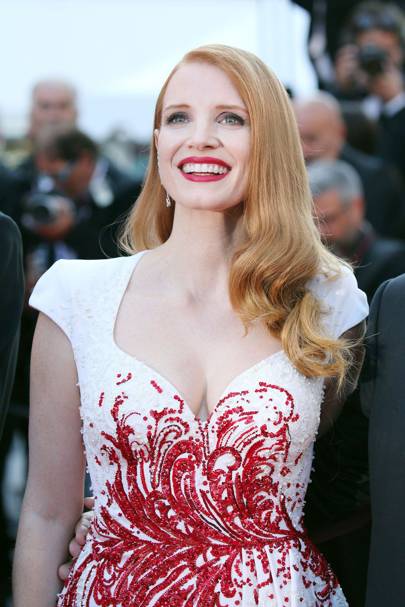
Oscar -nominated actress Jessica Chastain wed her long-term partner Gian Luca Passi de Preposulo on Saturday in the Italian city of Treviso. A handful of Hollywood stars joined the couple for the ceremony, which took place at the groom’s family-owned 17th-Century Villa Tiepolo Passi estate, situated 25 miles from Venice.

Chastain wore a custom-made strapless white gown with embroidered bodice and floor-sweeping skirt with beaded overlay. Though rumours suggested that it was created by Riccardo Tisci, due to the designer's attendance at the ceremony, the Alexander McQueen press office has now confirmed that the timeless piece was created for Chastain within the British fashion house.


Tisci was joined in Treviso by a coterie of fellow actresses and fashion elite. A Valentino-clad Anne Hathaway was flanked by husband Adam Shulman and Emily Blunt, who opted for vibrant Peter Pilotto for the service. Incoming British Vogue editor, Edward Enninful was kept company by Moncler chief executive officer Remo Ruffini, Giorgio Armani’s niece Roberta Armani and socialite Bianca Brandolini d’Adda, who wore Azzedine Alaïa. Some of stylish clan were spotted partying in Venice on the evening prior to the wedding.

The fashion circle is not alien to Passi de Preposulo, who currently manages the celebrity and events department of Italian label Moncler. He cut his teeth at Giorgio Armani as director of public relations. The Passi de Preposulos, meanwhile, hail from Italian nobility that dates back over 1,000 years, and produce their own prosecco, Prosecco di Villa Tiepolo Passi. Passi de Preposulo has been dating Chastain since 2012.

LFWM: All Eyes On Craig Green

Craig Green is on a deadline. Against the backdrop of one of the most significant elections in the history of the UK, the London-born, London-based designer and his team are working round the clock to complete his spring/summer 2018 collection before Monday’s show. And though there is nothing explicitly political about the 30-year-old designer’s work, it is hopeful, even utopian, in its own humble way.


Green is, without contest, one of the most important designers working in London right now. A graduate of Central Saint Martins’ famed MA Fashion course, he established his own label in 2012 to immediate acclaim. The accolades have come quickly. He was named Emerging Menswear Designer of the Year at the 2014 British Fashion Awards; and in 2016, he ascended to British Menswear Designer of the Year. Critics love him, and so do buyers. His designs are carried at Dover Street Market, 10 Corso Como, Selfridges and Galeries Lafayette. More recently, the director Ridley Scott tapped him to design costumes for Alien: Covenant.


"I find something romantic about people having a communal way of dress,” says Green. From his earliest collections, his work has been animated by his fascination with uniforms of all sorts and how they function both practically and conceptually. “My family were all tradesmen,” Green explains. “My dad was plumber and my mother was a nurse—they were working people who wore uniforms. The whole brand is based around ideas of communal dress, and romanticising things that might not really be so obviously romantic. That idea is something that carries all the way through in every single collection."

Green’s early work explored the connections between workwear and religious garb, culminating in his famously evocative spring/summer 2015 show. One of the most universally praised shows in recent memory, a number of audience members proudly announced that it brought them to tears. Its power came from the coherence and directness of its statement - the garments were all variations on a flowing, voluminous theme, styled in bold monochrome ensembles. This is a storytelling technique central to Green’s process. “Our idea is to make everyone work as one, through the clothing," he continues. "The way that the collections are designed, they start with colour blocks on a wall—the colour story and the rhythm comes first. It’s ‘black look, cream look, black look', before we even have clothes. For autumn/winter 2015, if you look at the line-up of all 30 boys on a wall, the colours make up the picture of a flag. It’s a procession of 30 boys telling that one story."

This all-for-one impulse reveals itself in Green’s cuts and detailing, as well. By taking tailoring cues from the loose, mass-produced sizing of generic uniforms and workwear, Green’s work tends to offer wide, forgiving cuts that almost anyone can find themselves in - men and women alike. Though Green considers himself a menswear designer, more and more retailers are purchasing his clothing with women in mind. "I guess it is unisex, but it’s more almost sexless,” Green says. “I can wear a jacket with a string-belted waist and not do it up, and then we have girls on our team who tie it at the waist to pull it in so it looks more feminine. It’s a play on function, using strings and simplistic ties to warp the silhouette of a boxy, simple garment."


Green’s last three collections have focused on rejuvenating quaint, overlooked fabrics and motifs from his past - like boy scout scarves in spring/summer 2017 - and the three before that were about, as he puts it, making something out of nothing. His next collection promises another thematic shift: “We’re romanticising the present a little more now, rather than the past.”

In a time of global turmoil and instability, Green’s tender approach is especially important. “I always saw fashion as escapist,” he says. “Even in hard times, people need to have dreams and fantasies.” But escapism is not just a comforting distraction, it’s necessary work - all possible worlds begin first as fantasies.

Meet The Women Shaping British Menswear

It´s often said that London’s menswear industry is a boy’s club – but reality paints a very different picture. As the worlds of menswear and womenswear grow ever closer, more and more women are striking out and putting their stamp on the category. As London Fashion Week Men’s gets into swing, we celebrate 10 women who are making it happen.


Lou Dalton

The Shropshire-born designer has become the poster woman for homegrown British menswear talent, and with good reason. Her 11-year-old eponymous label expertly straddles the divide between Fashion with a capital F, and clothes that work for real men’s wardrobe, whether on the Tube or halfway up a mountain. She honed her expert cutting skills as an apprentice to a bespoke tailor when she left school at 16, going on to study menswear at the Royal College of Art. “For me, it was never about womenswear,” she says. “Menswear is all that I’ve ever known.”

Ella Dror

After setting up a PR and creative consultancy with partner Ashley Smith in 2011, the 32-year-old founder of The Lobby quickly found her niche championing and nurturing new designers, especially those that mesh high-end fashion and streetwear. In fact, her client list has become the go-to when it comes to unearthing menswear’s next big thing. “I’ve worked with Astrid Andersen since the beginning of the brand and it’s still Astrid that excites me most today,” she says. Fashion East alumni Liam Hodges and Edward Crutchley are also on her books, and this season her much-lauded client Art School will make its debut on the MAN catwalk.

Grace Wales Bonner

The 26-year-old’s impact on British menswear has been swift and decisive. In 2015, just one year after graduating from Central Saint Martins, Wales Bonner was awarded Emerging Menswear Designer at the British Fashion Awards, and in 2016 she received the LVMH Prize. Her ascent might be unprecedented, but it is not undeserved. She deftly addresses the politics of identity, sexuality and race through her designs, transcending the confines of traditional masculine clothing, especially when it comes to pushing black male identity in fashion beyond the streetwear. As a menswear designer Wales Bonner is rare because women covet her designs as much as men. In fact, MatchesFashion.com’s buying team wanted to wear her clothes so badly that they asked her to recut pieces from her first collections for their womenswear customers.

Martine Rose

The 36-year-old designer is one of London menswear’s most original – and unsung – voices. Her nine-year-old label neatly combines impeccable tailoring with a subversive take on masculinity, and has won over international retail heavyweights including Barneys and Dover Street Market. In addition to running her own business, Rose also consults for Balenciaga menswear.

Lulu Kennedy

Often called “fashion’s fairy godmother,” Kennedy is the founder of designer support and showcasing scheme Fashion East, and a tour de force when it comes to championing emerging designers. In 2005 her not-for-profit organisation launched its menswear platform, MAN, in partnership with Topman. “I was at CSM’s MA show seeing all this fantastic menswear talent that had no platform, so I decided to make one,” she says simply. As well as a show on the London Fashion Week: Men’s schedule, participating designers receive a financial bursary, a Paris sales showroom, plus intensive mentoring. Recent recipients include JW Anderson, Grace Wales Bonner and Charles Jeffrey Loverboy.

Vanessa Kingori

Vanessa Kingori may have fallen into menswear “unwittingly” (her words), but the publisher of British GQ has already made an indelible mark on the industry. Beyond sponsoring London Fashion Week: Men's via GQ, she is also a fellow of the University of Arts, where she helps young designers evolve a creative vision into a financially sound fashion business. Kingori started out as a personal shopper at Matches, dressing the likes of Mick Jagger. She was awarded an MBE in 2016, and serves on London Mayor Sadiq Khan’s Brexit business advisory panel.

Sophie Jewes

The Starworks Group PR director is responsible for an impressive and eclectic talent roster, spanning WAH Nails, Kenzo and Ivy Park. But it’s the 29-year-old’s work with emerging menswear talent, including Charles Jeffrey Loverboy and the highly influential MAN/Fashion East young designer showcase, for which she is best known. “The best thing about this industry is the unpredictability, I mean, I met Charles Jeffrey on a dance floor,” she says. Prior to Starworks, Jewes headed up the fashion PR team at Selfridges.

Anna Pesonen

The Finnish stylist is one of the most exciting creatives working the menswear scene in London. A frequent collaborator with London Fashion Week: Men’s brands Xander Zhou and John Lawrence Sullivan, her approach merges subcultures past and present, with a fluid vision of male identity. She routinely contributes to the likes of Man About Town, Dazed, Interview and T magazine. A recent project with Dutch photographers Anuschka Blommers and Niels Schumm features a pot-bellied middle-aged male model looking resplendent in Raf Simons and Vetements. And that’s the thing about her work: she makes you look at menswear in a completely new way.

Astrid Andersen

A woman who proves there’s more to menswear than a sharp suit and tie, since launching her brand in 2011 Andersen has played a fundamental role in reimagining sports-luxe and challenging gender norms. Drake, A$AP Rocky and Rihanna are fans, and when the Danish designer needed a model for her Topman capsule collection, A$AP Ferg obliged. To dismiss her work as upmarket streetwear is to miss the point. She approaches menswear as an intellectual, and the results are often radical, sometimes jarring and always visually arresting.

Fiona Firth

Responsible for a mind-frazzling 400 brands, MrPorter.com’s buying director oversees the online luxury retailer’s total offer – and her impact on British men’s wardrobes is significant. Since taking the reins in March 2016, Firth has been quick to reflect the shifting menswear landscape. This includes launching an exclusive capsule collection with Gucci, and adding British designers spanning Craig Green, Stella McCartney, Connolly and Kent & Curwen. As a junior buyer, Firth says she favoured menswear because “I found that I could be more objective with male customers.”

The RCA Fashion Show: Our Favourite Moments

Marking the start of London Fashion Week Men's and the UK General Election, it's safe to say that it was a pretty poignant night for the Royal College of Art's annual fashion show. 48 talented MA students presented their collections through performance, installations, music and choreography to an audience of esteemed fashion faces. Earmarked as yearly showcase for fresh talent, Vogue rounds up the standout moments and the names to note.


Disco Fever

Walking into the industrial-like East London studio, audience members were met by bedazzling giant disco balls, creating an almost glitter-like environment for the show. Flashes of sparkling light made for a startling and electrifying setting; an apt atmosphere to mirror the exceptional creative talents of the designer collections that were on show.

Spiritual Awakening

First up was womenswear designer Zahra Sooty Hosseini, whose four-part gown design was showcased as audience members trickled it. Worn by a model sat with her head bowed down in a prayer-like position, the show began as three fellow models entered the runway, each helping to unclip the gown's billowing skirt so that it spread across the catwalk resembling a prayer-mat before all four women began to utter a series of prayers in sync. It was a powerful introduction to the innovative and politically motivated collections which followed.

Feathered Fancies

An invasion of colour, maximalist textures and a Miu Miu-like abundance of feathers brightened the catwalk as Rosie Danford-Phillips's collection took to the stage. Influenced by "an intense desire to infect sterile white spaces with nature", Danford-Phillips's uplifting designs added an injection of vibrancy to the roster of talent on display.

Redefining The Domestic Goddess

"Tick, tick, boom" were the words repeated from what sounded like a Forties radio recording as Pippa Harries's conceptual collection came down the catwalk. Her designs cleverly reflected the intrinsic domesticities of everyday life through a series of sartorial motifs, with one model dragging a tired-looking iron down the catwalk whilst another repeatedly blew her nose in a scrunched up hankerchief. "The dynamics to human interaction and how this translates in personality is prominent in my practice. I utilise this interest to investigate the relationship between wearer and their clothing habits, creating the archetypes of the ordinary routine. This allows me to appreciate tradition and classic line, whilst celebrating the ritual of routine," she explained.

Mad Hatters And Their Giant Apple

It was all Alice in East London Wonderland for millinery designer Jing Tang, who showcased her elaborate hat designs on three male models, wheeling out a giant apple which they subsequently opened to reveal a rotten interior. Citing Issey Miyake and John Cage as influences, Tang's unique exhibition concluded the show's first half with eccentric excellence. Once the lid had been lifted off the remarkably shiny apple, out came a stream of waiters offering flutes of champagne and pork sliders to the audience. A very classy combo indeed.

Topman's Gordon Richardson On The Art Of Collaboration

Gordon Richardson uses the word "We" a lot. While it is him that presides over Topman as its creative director, his delight in collaboration is clear in everything he does. From working with Luke Day on styling the Topman Design shows that have become a central fixture of London Fashion Week Men's, to his work with Lulu Kennedy’s MAN initiative that has birthed and nurtured some of the city’s brightest new menswear talents, he is keen to assert there’s no "I" in Topman. Ahead of the presentation of Topman Design’s spring/summer 2018 collection shown today, we took time to reflect at Topman’s London HQ.

“We are about collaboration and I like bringing people into the mix, I think it’s important," Richardson told us. "With a brand like Topman, you could just think as a high-street retailer or you can have people who think outside of that and work and collaborate with us and change what we do. We’re a better brand by having people we respect come in, like Luke who can contextualise it better than me and make sense of it better than myself and my team can.”

This collaborative prerogative will be put into practice today at the brand's presentation, where instead of its holding usual catwalk presentation, it will launch Transition; a multimedia event held in the Truman Brewery that will then be opened to the public (who can obtain tickets via the Dice app) over the weekend. At the centre of the event sits a carefully edited core selection of 15 looks that takes its inspiration from London’s post-punk party landscape: “That sort of dressing-up moment in the Eighties that was built around the Blitz club and stepped out of alignment with things that existed at the time," explained Richardson. “We then came up with the idea that we would do this event and have collaborators who would contribute and summarise Topman Design in their own way”.

These include the poet Max Wallis, whose exploration of love, youth and masculinity chimes well with Topman’s catwalk characters who have long wandered comfortably through countless eras and locales. For Transition, Wallis has put together a film that takes the idea of the myriad ways men can simply say "I love you."

Men’s fashion in London has felt a lot of love lately and, while London Fashion Week Men's kicks off its tenth season today, it is a universe that Richardson has been a celestial body in from the start. “It’s become something else now hasn’t it?” offered Gordon. “It’s become a thing”.


The week originated as a single day following the women’s collections of London Fashion Week, centring on Lulu Kennedy’s MAN initiative promoting three emerging designers each season in a similar format to her widely admired Fashion East initiative for womenswear. “I remember Lulu coming into this office many years ago and I remember the meeting room it happened. She passed us in another room and she said ‘Hey, why don’t we do men?’ and so we said ‘Fabulous, we’ll do it.' It was the most pioneering, exciting thing to be doing, watching MAN mature and those designers come to fruition."

While Topman sponsors MAN, Richardson is also a member of the panel that selects the designers whose alumni are a cross-section of London fashion talent from now-established names like JW Anderson, Christopher Shannon and Craig Green to new darling Charles Jeffrey.

“Somebody like Craig is the most perfect example. I mean he was pretty together right from the beginning, of course he was, but to watch him grow and watch him build his audience to that point that he could then take off.” But Gordon is keen to think long term with these talents and wants to protect a creativity that can too often prove fragile. “Some of them want to rush and you need to hold them back a bit and allow them to grow and I think that nurturing thing is very, very important. We have never just said 'Right, who’s the next thing?’"

And with that, he’s on to his own next thing to humbly and brilliantly help men across the land get dressed.

Sunday, June 11, 2017

Word On The Street? Mulberry Reigns Supreme

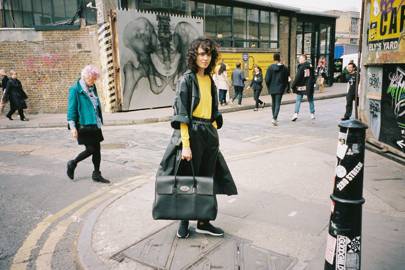
From the studded streets of Camden and the girls in pearls of Chelsea to the eclectic androgyny of Shoreditch, London’s style subcultures are constantly developing and reforming the British fashion scene. As the quintessential British brand, Mulberry’s pieces hit the right note at every stylistic level. These are real bags for real, modern lifestyles. Photographs by Yaniv Edry. Styling by Naomi Miller in partnership with Mulberry.

When asked what sources he focuses on in order to design his collections, Mulberry creative director Johnny Coca replies, “The women who wear Mulberry inspire me: how they carry their bags, how they make them part of their own style, their own lives.” In a similar vein, Vogue will forever consider accessories paramount in the modern-day obsession with “effortless chic”: employing bare essentials for maximum impact. Mulberry’s heritage and craftsmanship will always be admired, and Coca’s forward-thinking vision for both the accessories and the ready to wear is to be applauded.


In this series of street-style shots, Mulberry and Vogue have joined forces in capturing and exploring  how London’s style mavens employ real handbags for real-life style. Some improbable pairings, yes, and some classic alliances, but Vogue  believes these looks will have everyone and every occasion covered – be sure to make some time to marvel at the new bags at Mulberry.com. Bravo Johnny.

McCartney Has Stella Vision On The Future

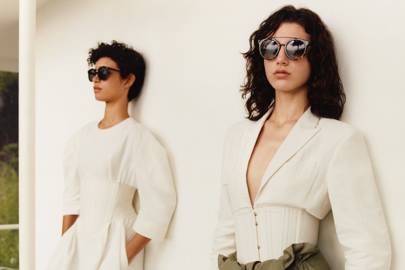
Inspired by the vibrancy of the season, Stella McCartney’s new sunglasses are designed not only with the modern woman in mind but also with a focus on what sustainable luxury looks like right now
in partnership with Stella McCartney.

The cool-girl credentials of Stella McCartney’s ready-to-wear collection have never been more at home in the designer’s sunglasses offering than this summer. With the promise of longer days and getaways to sunnier climes, the London-based designer has upped the ante on eyewear, presenting styles that will slot into wardrobes neatly without sacrificing impact, and promoting a modern, clean approach to summer dressing.

Sticking to the signatures that have contributed to McCartney’s design success, the frames look to both her past, present and the future. In off-kilter clay reds and printed with faux – naturally – python, they’re the perfect accomplice to the khaki paper-bag waists and contemporary take on shirting that populated her Paris Fashion Week show.

The rose-gold aviators will sit well on the face of the woman with a summer glow, who hops from Marrakesh’s souks to the trending landscapes of Colombia dressed in louche belted shapes and chicly sensible leather sandals. Meanwhile, that Vogue favourite, the unisex (another new branch added for the season ahead) caravan style, can be employed to bring the ever-elusive well-measured touch of androgyny to your favourite summer dress.


If your wardrobe already boasts a design from McCartney’s Falabella range, your eyewear can now boast the famed chain design, too. The handbag detail that has already seen clutch, tote and purse generations, is now commandeering the temple. In three different dimensions, it’s addition alongside is an eye-catching feature that offers the wearer a definitive marking to the knowing eye that you, too, are one of Stella’s empowered women.

Paralleling the ready-to-wear collection not only in design, but also in ethical stance, the shapes adhere to McCartney’s commitment to sustainability. The new addition of metal frames to the Stella Essentials range incorporates technically complex bio-lenses that are made from natural plant extract. McCartney’s stance is also evident elsewhere, with all of the 13 women’s styles being developed with a focus on using advanced technology and ethically sourced materials, such as bio-acetate, which has been created from renewable raw elements.

If there is any time of year that calls for a laissez-faire approach, it’s summer, and this offering of sunglasses needs little fuss to inject an additional jolt of cool to outfits that take you from city explorations to late-night dancing (the Falabella chains sparkle well under moonlight). After all, isn’t a dose of cool what everyone needs in a heady August heat? If anyone should know, it’s Stella.