Tuesday, October 31, 2017

Valentino Visits Tokyo, As Pierpaolo Piccioli Talks "Diversifying" Sportswear

At the opening of his sporty Valentino pop-up store in Tokyo, Pierpaolo Piccioli tells Vogue's Anders Christian Madsen how he finds diversity and unification in sportswear, and reflects on his intentions beyond fashion.

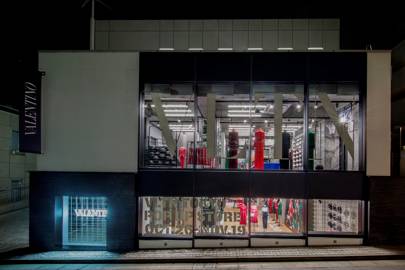
Pierpaolo Piccioli is showing me a video of Naomi Campbell and himself giving their all at karaoke the night before we meet in his Valentino pop-up store on a street corner in Harajuku. He’s a fan of the karaoke in Shibuya – “it has to be the room from Lost In Translation” – and Naomi happened to be in town. The creative director of Valentino first came to Tokyo fifteen years ago and fell in love with what he calls “the idea of classic culture mixed with extreme modernity.” Now he’s back for one of the sporadic events Valentino rolls out around the globe every year. This one, a pop-up store based on the luxe tracksuits of his sporty Resort 2018 collection, complete with basketballs, caps and water bottles branded “VLTN”, the house’s newest monogram. “This place is a new way of seeing Valentino; of getting the idea of couture and the traditions of the house, but pushing them into a different world,” he reflects.

"There’s something worrying about this reactionary world. I don’t like the intolerance. I like the freedom of being whoever you are."

Events in non-Western parts of the world have become standard practice for the big fashion houses; a way of keeping in touch with their global markets. But for the contemplative Piccioli, taking his show on the road is more than a clever business trick. “I always felt that fashion had a social responsibility, so delivering values you believe in is an opportunity to try to change people’s perceptions. It gives a sense to what I do — the hope that it can be more than just a piece of fabric.” A year ago, he invited me to Moscow for a similar Valentino happening on what proved to be a momentous day. There’s no way Piccioli could have planned it, but just hours after Donald Trump won the election on November 8th, we arrived in the country that played such a significant part in his campaign. That night, surrounded by likely Trump supporters in an upmarket restaurant in Moscow, Piccioli arrived casually wearing a cap with the slogan “Fuck Donald Trump.”

He still has it, he assures me, although his Tokyo cap of choice is an electric pink number he’s picked up from one of the stores in Harajuku — a more optimistic gesture on Piccioli’s part. “I didn’t expect anything good from what happened a year ago, so it didn’t surprise me,” he says, reflecting on the year that’s passed since our visit to Moscow. “That’s why we have to say every day, if we believe in freedom we have to work for freedom. I feel like I have to deliver with the collection the values I believe in: diversity and freedom. One year later, I think you have to fight for what you already have. You have to deliver through fashion the values of not only clothes. It’s a way to reflect what you believe in.” It was true for his spring/summer 2018 show in Paris last month, a highly philosophical Space Age collection that pictured the world we live in “from a Moonish perspective,” as Piccioli told me at the time.

His starting point was a conversation with his twenty-year-old daughter Benedetta, who had come across the poem Orlando Furioso by Ludovico Ariosto in her current studies. Written in 1532, it signified the first time the Moon was referenced as a physical place. “Every collection for me is born with a reflection about the moment I’m living in, and talking to her about this idea of the Moon as a second opportunity, as described in Orlando Furioso,was a starting point for me to reflect on a new perspective on Valentino, given all the things you already know in fashion. It’s a new opportunity to be seen in a different way,” the fifty-year-old designer tells me. His children with his wife, Simona Caggia, also count a son, Pietro, aged eighteen, and a younger daughter, Stella, aged eleven. “Having discussions with them makes me see things through their eyes, which are fresher than mine — less thoughtful, more immediate,” Piccioli notes and laughs.

“My daughters like fashion,” he notes, “but my son is not interested at all. I have the most conservative son. Maybe it’s a reaction to his father,” he quips. Piccioli doesn’t say it, but through his children he is given access to that most elusive of current phenomena: the millennial perspective, a generational point of view that turns stone to gold in the contemporary fashion climate. With their savvy social media ways, they’ve done exactly that to the sportswear sphere Valentino has now zoned in on for their Japanese outing — a contrast, perhaps, to the house’s haute couture disposition? “Yeah, but I don’t think couture is old. I think it’s a human approach to fashion,” Piccioli argues, noting that the white stitching on his Resort 2018 tracksuits were lifted from the hidden process of the couture craft. In Moscow last year, no doubt fuelled by the election that had just taken place, Piccioli reflected on his role as couturier in a contemporary world.

“There’s something worrying about this reactionary world. I don’t like the intolerance, the giving people boxes to stay in. I like freedom of being whoever you are,” he told me at the time. “My whole job at this house today is about individuality and evaluating diversity. Couture talks about a one-of-a-kind uniqueness. It’s about valuing diversity, and in this moment I think it’s super important to talk about diversity as beauty.” A year on, in Tokyo, he’s found the same message in the sportswear, which the millennial generation values as highly as haute couture. “In a way sport is the most universal culture, because it’s not divided into races, sexes or ages. Sport is for everybody,” Piccioli says. “I like it when something is so universal because then it can become very individual. Offering items like a tracksuit, a t-shirt, or a sweatshirt means you can wear them with your own personal style. It’s not a way of uniforming people, but an opportunity to diversify them.”

It’s the hyper-individuality inherent to the young people Valentino’s pop-up store in Tokyo is inevitably targeting, its Internet-like VLTN branding in tow, and an increasingly global spirit of a generation with a mindset set on change. “Sometimes we try to describe the new generation giving them tax. But I think they actually are exactly like this. They don’t care. They just are the way they are,” Piccioli says. “I like their freedom: just being the way they are, floating along with no boundaries.” On the backdrop of Tokyo, with all the futuristic Blade Runner and Ghost In the Shell associations it currently carries, this designer found the perfect scene to play out the humanist philosophies his era of Valentino has come to define. “I think Tokyo perfectly reflects the idea of transition as a starting point for modernity,” Piccioli points out, and no words could be a better conclusion to the newest chapter in his worldly Valentino conquests.

The #VLTNTokyo pop-up store runs until 19 November at QC CUBE, 4-21-8 Jingumae Shibuya-ku Tokyo.

The High-Street Bridalwear Launch Inspired By Bianca Jagger And Kate Moss

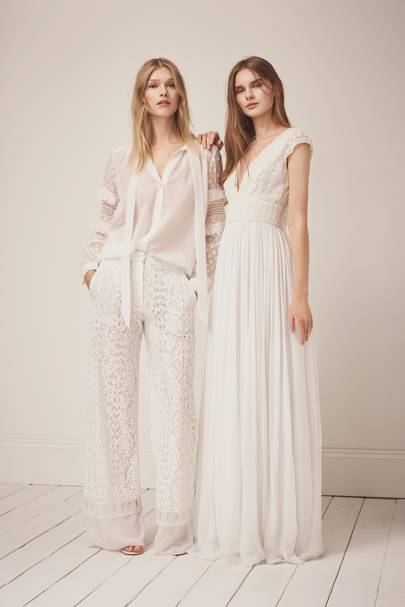
French Connection is the latest high-street brand to jump on the affordable bridalwear bus, with a spring/summer 2018 offering set to launch in February 2018.

“In recent years, we’ve seen customers making purchases from French Connection's main collections for their weddings,” design director, Maria Chen, told Vogue exclusively ahead of the launch. “Shoppers are able to buy affordable pieces in every other category except bridal, so it felt like a natural progression to launch a wedding capsule. With the growing trend of wedding dresses that don’t blow the budget, as well as bride’s wearing multiple outfits on the day, the idea was welcomed by our inner circle of brides-to-be.”


So, what can we expect from the £65 to £250 edit? Inspiration came from the wedding gowns of celebrity muses, such as Poppy Delevingne, Kate Moss and Bianca Jagger. Our moodboard was filled with the details that made their bridalwear special,” Chen elaborated. “For example, Poppy and Kate’s beading, Bianca’s tailored separates.”

The standout pieces, according to Chen, are the Cari dress, £250, which “features voluminous sleeves for a very romantic, bohemian silhouette”, the Palermo dress, £295, with “intricate detailing on the bodice and flowing skirts”, and the Comino shirt, £65, and Arta lace trousers, £120, which will appeal to directional brides-to-be.

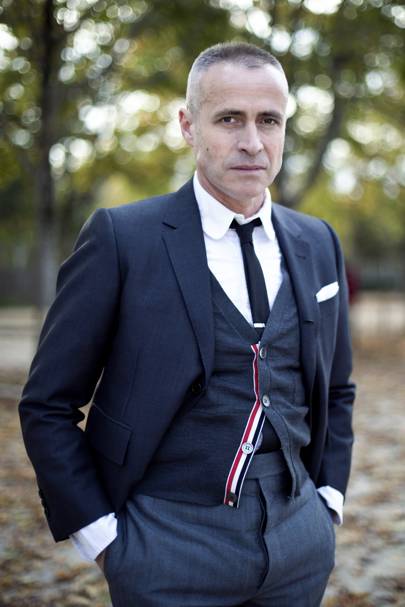
Thom Browne: My Shows "Are Not As Intellectual As People Think"

Thom Browne has long had a penchant for the theatrical. On the catwalk, he’s conjured up Victorian-era zombie brides with powdered faces and absurdly comedic tropical bird-people next to surfers at the beach. But for his Parisian womenswear debut, Browne upped the ante, even by his standards, greeting guests with a pair of majestic creatures—half-crustacean, half-cosmonaut— resembling blobs of chewed gum, playing the Little Mermaid soundtrack and unleashing a giant tulle unicorn operated by two model puppeteers, which quickly became the highlight of fashion month.

But as any customer of the designer knows, what Browne exhibits at his otherworldly and at-times bizarre shows bears little resemblance to the striped cardigans and button-down shirts one typically finds at more than 200 stores that carry his wares. Why is that? “I feel the shows should be conceptual. They should tell a story, and they should make the more plastic things that you do seem more interesting,” the soft-spoken Browne tells Vogue from his seat at the waterbar in the basement of the Parisian concept store Colette, where he is staging a takeover during the month of October. “I have a strong and classic part of what I do… what people see when they come to the showroom. There’s no reason I need to show that.”

Since establishing his label in 2001, Browne has been awarded, in addition to the CFDA’s Menswear Designer of the Year prize in 2016, 2013 and 2006, the Cooper Hewitt National Design Award in 2012, as well as the GQDesigner of the Year in 2008. By popularising the slim-and-shrunken silhouette in the Noughties, he launched a revolution in menswear that has transformed men’s tailoring more than anyone else since Giorgio Armani.

Though he’s been showing menswear in Paris for the past seven years, Browne only moved his womenswear show to Paris this season. With womenswear now contributing a third of total sales for the brand, he needed a bigger stage. “It wasn’t really about wanting to leave New York per se,” Browne says. “It does seem that there’s a bigger audience. And also an audience that appreciates more of the conceptual side of what I do.” Last year, Sandbridge Capital, the private equity firm, purchased a majority stake in the company from Stripe International, the Japanese investment firm. The company also appointed Rodrigo Bazan, formerly president of Alexander Wang, as the chief executive to expand the business, focussing on womenswear.

But unlike his Parisian counterparts, who might reference essays, films or the political climate in their collection notes, Browne often forgoes the highbrow in favour of the mundane. In fact, he’s often amused that critics dedicate so much of their time to interpreting his work. “For me, some of my inspirations are very sophomoric, and are not as intellectual as people think they are,” he says. “The idea of this show is the very simple idea of two little girls dreaming: it’s what I thought of when I would think of two little girls dreaming. It was true fantasy, including unicorns, and mermaids, so it was a very charming kid’s story.”


Though the references can be superficial or light-hearted, “the clothing is not a joke,” Browne assures us. “I am very serious about how the clothes are made, and the quality of what people see. Because I think that’s more of the fashion.” So never mind what the critics say, what was the real theme behind his Parisian womenswear debut? “The simple idea—not simple in actualising it—but the simple idea of taking my classic American fabrics and redeveloping it all in a fabric that I thought was very French, which was the tulle. And then also utilising tulle in a way that I don’t think is used very much, in a very tailored way.”

It’s hard to believe Browne didn’t train to be a fashion designer. Born in Allentown, Pennsylvania, Browne attended the University of Notre Dame in Indiana, where he studied economics and competed in long-distance freestyle races on the swim team. By chance, Browne found himself in the fashion industry after moving to New York in 1997, working in Giorgio Armani’s showroom before being discovered by Ralph Lauren, who hired him as a designer at Club Monaco after seeing Browne wearing one of his signature suits.

Today, Browne wouldn’t be caught in anything but a three-piece suit—except when he’s running—but he confesses he wasn’t born wearing a tie. During his Notre Dame days, “it was more grey flannels, khakis and navy jackets,” he divulges. After university and before moving to New York, Browne lived in Los Angeles, where he tried his hand at acting, and it was there on the West Coast that he developed a devotion to grey suits.

For those unfamiliar with Browne’s predilection for tailoring, it’s not enough that he wears the suits himself—the individuals he employs dress just like him too. Upstairs, where preparations are underway for a cocktail reception later that evening, a dozen or so men and women dressed in Browne’s uniforms are scattered across the shop floor. Soon, Sarah Andelman, the co-founder and creative director of Colette, will change into a Thom Browne suit of her own.

I observe that they all look the same. “We don’t look the same,” he interjects. “For me, I think there is something very strong and very individual and unique about uniforms,” he explains. “I think it does really showcase each person’s individuality. Look at us: we are wearing the same thing, but we look very different, and we are all very different people. I think that’s a very strong message.”

Celebrating 50 Years Of The Levi's Trucker Jacket

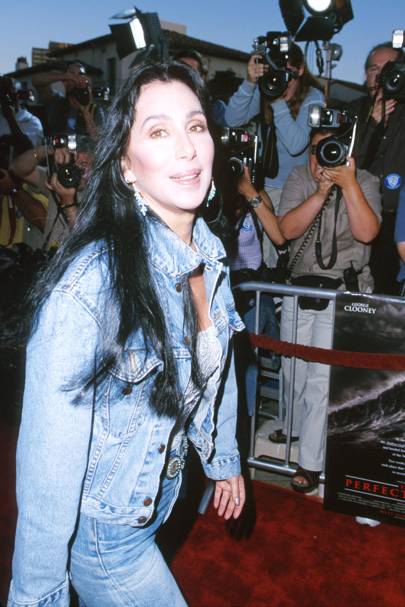
This month, Levi’s celebrated the 50th anniversary of its trucker jacket by inviting 50 close creative friends and collaborators (a cross-section of fashionable culture from Vogue Paris’ Emmanuelle Alt to legendary Belgian design duo AF Vandevorst) to redesign its landmark denim piece. The brand toasted it with an exhibition and party in West Hollywood. On the bill: Snoop Dogg DJing and sets by Solange and Chance the Rapper.

Naturally I was honoured to help them celebrate, and in packing came across a completely obscured version of the jacket I forgot I had, originally belonging to my late father. Mercifully returned by an ex- boyfriend a couple of years ago, the jacket bears a label reading “Made in Australia” and family legend has it that the curiously-textured suede is that of kangaroo. I romantically hold on to the notion, and can partially support it with admittedly cursory research.

A quick history lesson on the trucker: born in 1967 as the third generation of the Levi Strauss jean jacket, the trucker was gifted its name by a Japanese market who characterised the classic piece of Americana as typical garb of coast-to-coast truck drivers. Mostly (but not always) hewn of denim, the trucker’s defining features include the diagonal seams beneath each pocket that taper in a chevron to the hem. The same year, that of the nostalgia-steeped Summer of Love, saw George Harrison gather a crowd of followers as he wore his own trucker to visit a relative in San Francisco.


The denim jacket belongs to American pop culture as much, if not more than the blue jean. From Martin Sheen’s Badlands bad boy to Madonna in early incarnation as ingénue starlet, the garment has been a canvas for countless reinventions and projections of youthful, earnest bravado. Indeed it doggedly persists into modernity: Levi’s newest evolution of the trucker comes fashioned in jacquard, a groundbreaking new fabric developed with Google incorporating an intelligent yarn that can read and act upon a wearer’s movement; a still-nascent technology but with untold possibilities for the future. So wherein lies the longevity of the garment? Perhaps it is the well-built nature of the piece. Proven in endless destroyed and deconstructed versions: you can bleach, you can shred, you can wash with stones and the denim will never break - at least not enough to withstand at least one more inheritance.

And so I inherited my father’s trucker, one even tougher and (purportedly) made from a suede 10-times stronger than cowhide. I hope it went with him to the Isle of Wight Festival in 1970 and to countless gatherings of mods on Brighton beach he grew up on. I might only have worn it with pseudo-grit to a glamorous gala for its own golden anniversary, but I know enough to say it will mean something else to someone again, somewhere down the line.

The Fashion Awards 2017: Meet The Nominees

The nominees for the 2017 Fashion Awards in partnership with Swarovskihave been revealed ahead of the December 4 ceremony at London’s Royal Albert Hall. “These designers and brands were chosen from hundreds of international names and they represent the most creative talent and innovative businesses of the year,” BFC chairwoman Natalie Massenet told press at this morning’s briefing. As well as the household names on the list, a handful of industry favourites, including London Fashion Week’s bright young things Michael Halpern and Matty Bovan and Samuel Ross, a protégé of Virgil Abloh’s, have received their first nominations. Breakout runway star of the spring/summer 2018 shows, Kaia Gerber, has also been recognised in the Model of the Year category, and is the youngest of her catwalk colleagues in the shortlist.

British Emerging Talent - Menswear


Ben Cottrell and Matthew Dainty for Cottweiler
Charles Jeffrey for Charles Jeffrey Loverboy
Henry Holland for House of Holland
Phoebe English for Phoebe English Man
Samuel Ross for A-Cold-Wall*

British Emerging Talent - Womenswear

Faustine Steinmetz for Faustine Steinmetz
Matty Bovan for Matty Bovan
Michael Halpern for Halpern
Natalia Alaverdian for A.W.A.K.E
Rejina Pyo for Rejina Pyo

Business Leader

Adrian Joffe for Dover Street Market
Guram Gvasalia for Vetements
José Neves for Farfetch
Marco Bizzarri for Gucci
Ruth and Tom Chapman for Matchesfashion.com

Model of the Year

Adwoa Aboah
Bella Hadid
Gigi Hadid
Kaia Gerber
Winnie Harlow


The SS18 Model Awards

Urban Luxe Brand
Fenty Puma by Rihanna
Gosha Rubchinskiy
Off-White
Supreme
Vetements

Accessories Designer of the Year


Alessandro Michele for Gucci
Anthony Vaccarello for Saint Laurent
Demna Gvasalia for Balenciaga
Jonathan Anderson for Loewe
Stuart Vevers for Coach

British Designer of the Year - Menswear

Christopher Bailey MBE for Burberry
Craig Green for Craig Green
Grace Wales Bonner for Wales Bonner
Jonathan Anderson for JW Anderson
Martine Rose for Martine Rose

British Designer of the Year - Womenswear

Christopher Kane for Christopher Kane
Erdem Moralioglu for Erdem
Jonathan Anderson for JW Anderson
Roksanda Ilincic for Roksanda

Designer of the Year

Alessandro Michele for Gucci
Jonathan Anderson for Loewe
Maria Grazia Chiuri for Dior
Phoebe Philo for Céline
Raf Simons for Calvin Klein

Rendez-Vogue: Demna Gvasalia

The first in a series of casual interviews, Vetements and Balenciaga designer Demna Gvasalia opens up to Vogue’s fashion critic Anders Christian Madsen about his new lifestyle and the chaotic shoot to fashion fame that went before it.

A traditional Parisian restaurant in the 7eme wasn’t what I had expected when I asked Demna Gvasalia to take me to lunch in late August. He turns up looking ever the rock star, in a graphic geo-print prototype Balenciaga shell jacket and matching cap pulled down halfway over his eyes. “You brought me out of this no-press hibernation period,” he reminds me. In the past year the Vetements designer has evaded the in-depth conversations of the first part of his career in the spotlight, a skyrocket, which – mad as it sounds to anyone with a wardrobe full of his impossibly long-sleeved hoodies and artisanal jeans – only took off in 2014. In January this year, he amazed his industry by relocating Vetements to Zurich (of all places) with his brother Guram Gvasalia, the brand’s CEO. “My lifestyle changed completely in one year. I’m a different Demna now,” he declares, and orders a fresh lemon tea. The brand had become a banner leader for a new avant-garde youth in Paris and around the world, thanks to a social-media generation of millennial streetwear worshippers, whose hearts Gvasalia’s subversive designs pierced at the right time and place.


His adoptive home wasn’t the catalyst for the reformed Swiss lifestyle the 36-year-old designer now swears by, with all the runs by the lake, vegetarianism and no-alcohol-or-cigarettes policies it has entailed. It was the solution. “I felt suffocated by that new wave that we became part of with Vetements. It got to the point where I got fucking bored of it; being associated with nightclubs, Paris youth, the gang,” he admits. “It’s great, but I felt Vetements grew out of it, partly due to the commercial success but mainly because we grew in every way. I felt we needed to get out of it, but it’s a good thing it now exists, for others to evolve it further.” The out-of-nowhere rise of Vetements – and Gvasalia as the star-is-born designer – resonated with a new order in the fashion establishment, where houses suddenly dared to hire emerging or unknown designers (beginning with Alessandro Michele at Gucci, and followed by Anthony Vaccarello at Saint Laurent) and rogue cult brands rapidly took centre stage (Off-White, Gosha Rubchinskiy, Koché, to name a few).

"I felt suffocated by that new wave that we became part of with Vetements. It got to the point where I got fucking bored of it".

Gvasalia became creative director at Balenciaga in that process, and he’s meeting me between fittings – Le Petit Lutetia is down the road from those ateliers. A charming (and suspiciously fashionable) restaurant decked out in Belle Epoque mirrors, wooden screens and the occasional palm tree. “It’s not just because it’s close to Balenciaga,” he insists. “I actually come here on the weekends when I’m in Paris.” Now in a long-term relationship with Loïk Gomez, a metal musician who sometimes walks his men’s shows, Gvasalia is about to move out of his old bachelor pad on Rue Saint-Martin, which has a view to Jean Paul Gaultier’s office, and which he took out at the height of his Prince Bertie-worthy Parisian debauchery years. “I can’t any more. We have people getting run over in the street at seven in the morning. It’s so loud. Plus, I can’t listen to music loud because of neighbours,” Gvasalia says, eyes rolling. His new home away from Zurich? Bois de Boulogne, where he showed his last Balenciaga men’s collection, and “where there’s no outside noise and I can play music as loud as I want”.

So perhaps this trendy bistro wasn’t so misrepresentative of the new Demna Gvasalia after all. The food arrives: parma ham, melon and king crab for the writer; tomato salad and an enormous artichoke for Gvasalia, the awkward desirability of which could easily be a metaphor for the garments he makes. Trying to be ladylike fiddling with the leafy alien, he breaks into laughter. “I feel like Audrey Hepburn!” Is this his life now, then, elegantly nipping at artichoke leaves in bourgeois Parisian establishments? “No,” he says. “My life is happy now.” Was there a time he wasn’t? “Yeah. Remember the show I did in the church?” Gvasalia pauses, referring to his autumn/winter 2016 show with the famous slogan jumper, “May The Bridges I Burn Light My Way.” “That was the heaviest time I ever experienced. A lot of shit was going on in my private life and I didn’t really know what I wanted. In my professional life I was doing what I loved doing, but I had a relationship that didn’t work,” he reflects. “A lot of things changed for me when I started doing two jobs and having less time for friends; taking a healthier path changed my relationships with people.”

Being “the coolest man in Paris”, as I called him when I first met Gvasalia at the dawn of the super-fame that would hit him like an avalanche of groupies, would become a claustrophobic box to live in. Alongside his fellow fashion Soviets – the designer Gosha Rubchinskiy and the stylist Lotta Volkova – he inadvertently became the poster boy for a trend that was simply part of his roots, growing up in Georgia’s now-separatist Abkhazia region and fleeing civil war on a donkey over the Caucasus Mountains at age 14 – a harrowing childhood story too heartbreaking for this jovial lunch to do justice. “Sometimes I have to tell my boyfriend about this period of my life he doesn’t know about. Georgia, the mountains, selling Kalashnikovs... I always feel a bit ashamed, as if people think I’m bullshitting them.” His family eventually relocated to Düsseldorf where Gvasalia spent his late teens, although they briefly lived in Russia.

“This Russian thing, I can’t any more,” he announces, having conquered the artichoke. “They put me, Gosha and Lotta in this one big Russian rustic bucket of post-Soviet dirt,” he laughs. “We’re all friends, we work together. There’s not so many Russian people in fashion. I love Russia, Russia is my home country in many ways, but I don’t like many things about Russia today related to the political mentality.” Those post-Soviet waves were washing over fashion when he did that show in the church and wore the T-shirt backstage about burning bridges. “That was the way I felt at the time. It was about myself. I always tried to do things for other people, or for my parents to be proud of me, but I never thought about myself until the moment I realised it’s quite self-destructive,” he reflects. “But you shouldn’t burn all the bridges.” Slowly, as his fame and fortune grew and Justin Bieber was Instagramming deifying pictures of him, a new Demna Gvasalia began to emerge. “It motivated my decision to discover who I truly am, and to love and appreciate myself and my life, and the people around me – even if it’s only a few people,” he says.


As for those no longer a part of Gvasalia’s reality, “it happened naturally because you don’t have the lifestyle any more. It’s a kind of therapy: to understand what real friendship is, and what people you can actually rely on. I thought, I want less... but more quality.” It triggered his new way of life. “I went to do yoga, can you imagine?” he laughs. “Well, I went once...” Now appropriately illuminated by a complimentary plate of radishes, Gvasalia is full of reflections on mindfulness and wellbeing – worlds away from the chain-smoking encounters we had during the first stage of his career. “When you finally reach the point where you think, ‘There’s nothing else I can talk to Demna about’ – there’s meditation!” he quips. But Gvasalia is in no way annoying or holier-than-thou about his born-again sanity. Rather, it’s clarified the charming no-nonsense casualness that made us fall at his feet in the first place, as the breath of fresh air fashion so needed."It’s a kind of therapy: to understand what real friendship is, and what people you can actually rely on".

“Fashion is sex, drugs and rock’n’roll, but for me it’s also responsibility and my interest in clothing, which I don’t want to become a Fashion-Week experience. I needed the silence and to go and discover myself,” he explains. “I’m still doing it and I’m going to be doing it for the rest of my life.” Practically incognito in Zurich, which he’s affectionately described as “the most boring place in Europe”, he’s had space to geek out on fashion, true to his nature. In June, Gvasalia presented a Vetements collection shot there on locals in the cliché fashion poses he’s been obsessing about. Classic lookbook poses were the inspiration for his previous Balenciaga women’s collection, while he said his spring/summer 2018 outing in October (presented a month after this lunch) signified his most personal work for Balenciaga yet. Both brands continue to make waves on the social-media channels that fuel Gvasalia’s star power. Last season, his IKEA-esque Balenciaga bag spawned an entire capsule campaign from the Swedish homeware giant, while Gvasalia’s election-inspired Balenciaga motifs, not dissimilar to those of Bernie Sanders’s campaign, got a mention from the presidential candidate in a cable news interview. That notion does bring a smile to Gvasalia’s face, but he’s not one for the social-media circus.

“Oh no, those things I don’t react to. For me it’s a bit like the whole Vetememes thing,” he says, referring to the unofficial meme outlet devoted to his brand. Other phenomena include Petements, an Instagram account that imagines pets in Vetements. “The internet craziness... I don’t want to get involved. It becomes a bit slapstick. I don’t like slapstick,” he shrugs. “I’m working on a project that will be my answer to all of that, in January. I’m going to answer with a collection,” he teases. “You will see. Next season is the first season I’ll do it. It’s maybe something most people think you should never do. I feel like this excites me. We had a lot of options: what could it be? So I thought, let’s take the worst and let’s work with that. Something nobody would expect you to do. For me it’s linked to the past of Vetements; where we come from.” He doesn’t mean Georgia, although he happily answers fan mail from kids in his home country. “If someone did that to me when I was a kid, it would probably have had an influence.”"The internet craziness... I don’t want to get involved. It becomes a bit slapstick. I don’t like slapstick"

The fame, however – much as it clings to him – is not a guise Gvasalia wears with ease. “It’s disturbing. It’s flattering, but I can’t do it, because maybe I’m not that comfortable with myself, still. I don’t think it will ever be part of my character.” Rather than basking in the spotlight offered to him on a plate by his social-media-savvy millennial super-fans, Gvasalia has become their friend and defender, in a time when the media paints out the so-called snowflake generation as complacent and fame-hungry. “My millennial friends are not that way,” he argues, now on to a decaf coffee. “The people I know, who are 10 years younger than me, they’re all very ambitious and work hard. They’re also very good people. The values they have in life are good: they don’t want war, they don’t judge, they’re for diversity. There are so many good things about this generation. They just want it different. They want to have fun. They want to have money to have a good life,” Gvasalia says, and pauses. “Why not? That’s not a bad thing.”

Burberry Chooses Net-A-Porter To Launch First September Capsule Collection

Burberry is no stranger to the pages of Net-a-Porter (it's been stocked there since 2005, in fact), but its new exclusive edit for the online retailer is the first time that it has especially created an additional collection inspired by its catwalk show.

Billed as an "an eclectic mix of British iconic staples", the 14-piece edit is a new extension of the brand's see-now, buy-now model and comprises "delicate lace dresses and gowns, plastic waterproof outerwear, form-fitting jodhpur trousers and long tartan check skirts".


When chief creative officer Christopher Bailey debuted his vision for the season back at London Fashion Week, Vogue's fashion critic, Anders Christian Madsen, said, "If his sculpturally romantic last two Burberry collections, years on, whetted a younger audience’s appetite for his new direction, this collection was the climax to that transition." Now fans have even more to covet thanks to this extension of its runway-to-retail model.