Thursday, October 12, 2017

Dolce & Gabbana's Christmas Market Comes To Harrods

Stefano Gabbana loves Christmas. Every year on the December 24, he and Domenico Dolce, his design and business partner of 32 years, stay up until midnight to usher in the holiday. Later, on Christmas Day, the pair host a lunch for 25 or 26 – “children, uncles, nephews, brothers, sisters... we mix our families,” Gabbana tells Vogue. There is always a tree, hung with dozens upon dozens of mementoes, the result looking like “total chaos, a flea market.” Everyone is asked to cook a dish – and this being Italy, there is always a meat ravioli – though Gabbana usually cheats and buys something. “I’m not a good cook,” he confesses. “Domenico is very good.”

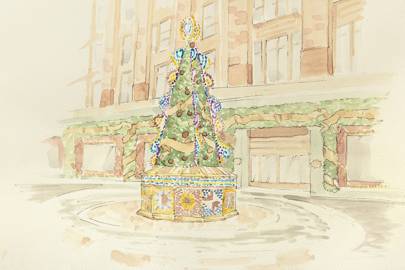
While only a few can enjoy the privilege of dining in famiglia with Dolce & Gabbana, this holiday season, shoppers in London can at least get a little taste. From November 2 until December 28, the designers are setting up an Italian Christmas Market inside the lacquered walls of Harrods. There will be a tree out front, decorated not like a flea market but in gold ribbons and colourful lights. The windows will be designed in the style of a Sicilian puppet theatre, with Dolce and Gabbana appearing in marionette form to introduce passersby to the story of the house.


On the fourth floor, visitors will walk into a replica Italian piazza strung with coloured lights. Booths will display a variety of goods, many designed exclusively for the department store, including floral and sequin-embroidered women’s evening dresses, festive men’s suits in striped lurex and silk shantung, and children’s ready-to-wear. Those on the hunt for gifts will find displays full of toys, fragrance, fine jewellery, shoes, handbags and other accessories. Dolce and Gabbana have even engaged a painter to personalise any Sicily bags purchased on site.

This is not the first time Harrods has invited a single brand to deck its halls for the holiday. Last year, Burberry installed “A very British fairy-tale” in the store’s windows, with items designed just for Harrods available for purchase inside. In 2015, the brand was Samsung.

“We put our personal [selves] in everything we do,” Gabbana says of this year’s takeover. “For me, Christmas is the tree and the nativity, friends and love and all of the most warming things… and now we are bringing it to Harrods.”

Monday, October 9, 2017

Words Of Wisdom From Edward Enninful and Marc Jacobs

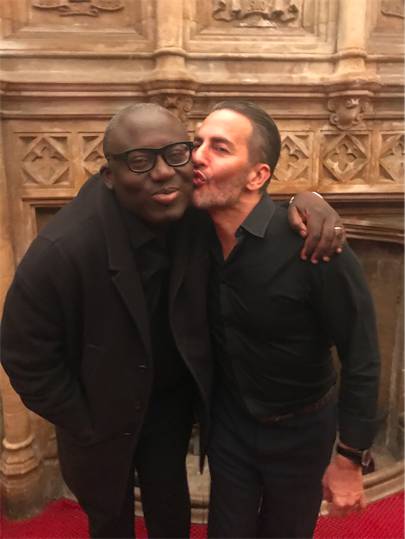
Last night, Oxford Union hosted Edward Enninful and Marc Jacobsin a conversation that spanned everything from the importance of diversity to the fantasy of fashion. Here, we highlight some of the words of wisdom that they shared: an insight into the mind of two of the industry’s most celebrated figures.

“I didn’t grow up with money; I didn’t come from a rich family. But what fashion gave me was an escape into a world of creativity: if I couldn’t afford that Junior Gaultier jacket, then I’d get one from the market and customise it. Fashion brings out your creativity; when he shows a collection, Marc’s not just saying, ‘here’s a dress, go buy it.’ He’s saying, here's an idea of what you can be, or become.” – Edward Enninful

“Fashion is for everyone: owning a dress isn’t what it’s about. I mean, it’s a great thing if you have the ability to buy something – but, like with art, like with music, you don’t have to own it. If you can experience fashion, if you can relate to it, if it moves you or inspires you in some way then you can go out, get that jacket, hack into it, put some shoulder pads in – or maybe it’ll encourage you to do something completely different. But that’s what creativity does: it stimulates and inspires people. Ownership isn’t the important thing." – Marc Jacobs

“When you leave your house in the morning, however you dress is the way you want the world to see you. I think fashion can tell a story about celebrating difference, can talk about how different people are, how diverse people are – and for me, that’s where fashion really succeeds, when it tackles things to do with the world we live in.” – Edward Enninful

“Whether people are into fashion or they aren’t, they still express themselves somehow, with the clothes they choose: whether they want to be a part of something, whether they want to be apart from something. Fashion is just a form of self-expression. I love the idea that all the world’s a stage, and that we all costume ourselves for this great piece of theatre that we perform every day. What has always interested me about fashion is identity, and the idea of creating identity.” – Marc Jacobs

“My memories of London Fashion Week are of starting out and not getting many tickets for fashion shows, but wanting to see them so much that I’d sneak in with my friends, people like Pat McGrath and Craig McDean. We’d try to find somewhere to hide, somewhere to sit on the floor, anything; we were just so excited to be there. Then I remember later, seeing Lee McQueen’s shows, and the fire, and Shalom Harlow being sprayed with paint… and today, you have people like Jonathan Anderson, like Molly Goddard. So, for me, London Fashion Week has always been about setting the trends, about creativity. There might not be a lot of money, but there is always a lot of creativity.” – Edward Enninful

“I always got the feeling that American design schools turned students into good assistant designers – but that, at Central Saint Martins, there were professors who were pushing their students to be creative, to express themselves, and to find a voice to express their vision. It’s very different to the underlying message of fashion education in the US, and I think that’s reflected in the shows: during New York Fashion Week, with a few exceptions, it feels like a presentation of commercial product whereas, in London, it’s about designers expressing their vision. It isn’t a bad thing, it’s just different – but both cities have a youth culture that’s amazing and, in my mind, although they’re very different, there’s a similar energy there.” – Marc Jacobs

“At its essence, fashion is about taking inspiration from everywhere: different countries, different histories. Cultural appropriation is a very delicate subject but, if someone is inspired by something, then as long as they tell you where it’s from, acknowledge the history of where an idea came from, then I’m fine with it. We work in fashion, and it's a dream, but we should credit the source.” – Edward Enninful

“I learned a very valuable lesson after I showed a collection that included woollen dreadlocks worn on the girls’ heads: I had been inspired by Lana Wachowski, The Slits, rave culture, Marilyn and Boy George from the Eighties and I didn’t feel like I was doing anything wrong – those were my references and I didn't think that, by showing that collection, I was saying they were the origin of dreadlocks – but it caused this whole thing. I think that it’s very dangerous to say, you can’t look at that, you can’t use that, you can’t borrow from that or be inspired by that – I think that’s setting people up to stay in their own lane and I think that’s a dangerous way of thinking. But what I learned from that experience was that it’s important to be sensitive, especially when people say something hurts, or feels like appropriation. That you need to listen to what people have to say and that, if somebody is expressing something, some pain or some problem, then you need to listen to why. I don’t believe there should be a border patrol on what’s okay to look at or be inspired by, so I stand by that, but I did learn that a conversation requires listening to the other person talking.” – Marc Jacobs

“Fashion can say a lot about the times we live in: about race, about creed, about size. Now more than ever, people are really embracing that. Diversity really is the word, and it’s about enjoying our difference; I always believe that a diverse range of voices is more powerful than one singular vision or voice. I don’t believe in tokenism, but different people being a part of the conversation in order for us to move forward? That I like.” – Edward Enninful

“Look at women in Fifties advertisements, with corsets on, full skirts, standing in front of a washing machine. That’s what society thought women’s’ role was: to look nice for their husband and take care of the home. But right now, there’s a new desire to see people – all people – doing different things. That’s what’s stimulating. It goes beyond responsibility: it’s just so much cooler, fresher, nicer, more exciting to have your eyes wide open, to take as much in as possible, to hear different voices and see different things. And thank God for that.” – Marc Jacobs

On The Life And Legacy Of Hervé Léger Designer Hervé L. Leroux

Hervé L. Leroux, the French fashion designer who made his name in the 1990s with his second-skin, bandage dresses died on October 6 2017, the Fédération de la Haute Couture et de la Mode confirmed. He was 60 years old.

Internationally known with the name of his first label, Hervé Léger, Mr. Leroux created one of the defining styles of the Nineties. His form-fitting designs, made by stitching together individual strips of materials that shaped and sculpted the body became the ultimate supermodel uniform. Made in a rainbow of colours, Mr. Leroux’s creations embraced and enhanced every single curve of the wearers’ body, perfectly celebrating the sexually-charged femininity of the era.


Mr. Leroux was born Hervé Peugnet in Bapaume, a small town in the north of France, on May 30 1957. Abandoning his studies in sculpture and art history, in the late Seventies he worked as a hairdresser and a milliner before meeting Karl Lagerfeld in 1981. Mr. Leroux worked side by side with Mr. Lagerfeld at Fendi and Chanel, before opening his first boutique on rue du Pélican in 1984. The boutique – launched under his new name of Hervé Léger, as advised by Lagerfeld himself – specialised in hand-painted dresses and hats, and became one of Paris’ chic shopping destinations.

In 1985, Mr. Leroux launched his own brand, but continued to freelance for other designers on the side, including the house of Lanvin, Daniel Swarovski and Charles Jourdan. The real breakthrough came with his first show in 1991, when he presented 54 outfits in front of a small crowd in Paris. The moulded style of his dresses, and their body-conscious silhouette, caught the eye of the press. “Léger proved why Paris is the center of fashion creativity,” wrote The New York Times after the show. “His collection was original, well thought out, knowledgeably executed and about as incendiary as style can be these days.”


Hervé Léger was acquired in 1998 by the Los Angeles-based group BCBG Max Azria and Mr. Leroux parted ways shortly after, losing the commercial use of his name in April 1999. Undefeated and with the support of his loyal clients, he continued to design custom orders, evening gowns and swimwear under the name Hervé L. Leroux from his new boutique on 32 rue Jacob, Paris. "My clients come from all over the world,” he told Suzy Menkes in 2000. “A woman who likes the silhouette of her body to be made the most of, not with drapes and decoration but with structure.” In 2013, after a 12 year hiatus from the catwalk, he was invited by the Fédération de la Haute Couture et de la Mode to show as a guest during the Couture schedule in Paris.

Dita Von Teese, one of his most loyal customers, remembered him on Instagram. “I’d say he was the only dressmaker that could accomplish a truly modern Madame Grès goddess gown,” she wrote. “I loved him for his wit, his candour, his sublime elegance and of course, his talent, which came from authentic obsession, with no care for the commerciality of fashion.”

2017’s Sassiest Collab: Victoria’s Secret X Balmain

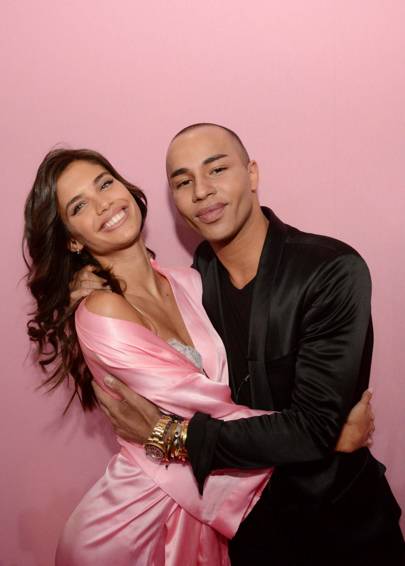
Victoria´s Secret has tapped Balmain creative director Olivier Rousteing to create custom looks for its annual catwalk spectacular, and a capsule collection to launch in stores on November 29 th, the day after the show airs on US network CBS.

Though the lingerie giant has called upon designers to create runway pieces in the past, the #VSxBalmain tie-up will mark the first time the brand has partnered with a fashion house on an in-store collection.


The tie-up is a natural fit, as there’s plenty of crossover between Rousteing’s Balmain Army – the gang of girls who religiously star in his campaigns – and the models Victoria’s Secret calls upon to bring star factor to its runways. Come the Shanghai showcase on November 28, it’s highly likely that the French designer will choose sassy friends Sara Sampaio, Joan Smalls, Alessandra Ambrosio and Karlie Kloss to model his first mainline foray into underwear.

For now, there’s only a carefully curated Instagram collage to glean information from. The black-and-white poster features both brand names scrawled across it, in what looks like a punk tribute to Sex Pistols' album artwork of yore. And is that a little leopard-print we can spot in the top corner? Stay tuned for what will undoubtedly be 2017’s fiercest partnership.

Inside Hermès's Pop-Up Hermèsmatic In Manchester

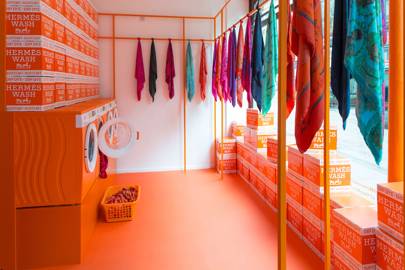
Hermes orange is unique, but rarely is it seen in quite the quantities now filling the Manchester boutique, relaunched today to host the luxury label's Hermèsmatic pop-up.

For a start, there is the wall-to-wall Tango-tastic carpet. Add to that a highlighted handrail on the spiral staircase - and the steps themselves - followed by washing powder boxes emblazoned with the brand's moniker piled high in the carrot colour. Eames-style plastic chairs sit bright, and Aperol-hued wash baskets are filled with tie-dye silk scarves. From a metal frame hang more scarves, like a chic washing line, completing the retro-style launderette.


Opening for the first time in the UK (the pop-up launched in Strasbourg over a year ago and has since travelled the world), the Hermèsmatic concept is simple: to breathe new life into vintage Hermès scarves by dip-dying them in one of five colours; denim blue, fuchsia pink or vibrant red, turquoise and orange. The colour wash happens at the Hermèsmatic pop-up - you can see the machines in action - and two days later, the new look silk is ready to collect from the Selfridges store down the road.

The Manchester outlet will only be open for a week, through to October 12, and will host free silk styling workshops, teaching shoppers how to transform their silk scarves into headpieces, bags, crowns, clothing and more. A bright idea, if ever there was one.

Why Blade Runner 2049 Could Be Significant For Your Wardrobe

It’s not often that one wonders whether Blade Runner star Joanna Cassidy is following the trends. The industry’s current fling with plastic macs might amuse the US actress, however.

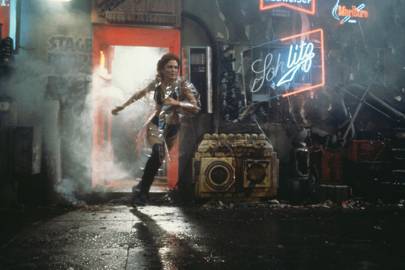
As replicant Zhora Salome in Ridley Scott’s sci-fi epic, she throws on a transparent raincoat to shield her from the heavy downpour while trying to escape blade runner Rick Deckard, who is set on her demise. Underneath her see-through mac for all to see lay a skimpy two-piece and knee-high boots – her stripper’s uniform – as she charged through a dystopian LA like a futuristic gladiator intent on losing her assassin while keeping dry.


From 1982 to the spring/summer 2018 shows, which saw the fash pack wearing Calvin Klein’s plastic-topped checked mac and Miu Miu’s transparent trench – two much-lauded pieces from the autumn/winter 2017 collections. As the trend picks up pace for next season - everyone from Calvin Klein to Chanel and Valentino has experimented with translucent vinyl - Scott's Eighties classic, which predicted what 2019 might be like, seems oddly apt.


With the sequel, Blade Runner 2049, airing in UK cinemas this week, look closely at the costumes - new director Denis Villeneuve might have the same knack for spotting trends as his predecessor, Scott.

Chanel Falls: A Guided Tour

Each season the Chanel set is the talk of Fashion Week. Like the Cecil B. DeMille of fashion, Karl Lagerfeld instructs his team to build epic constructions and create detailed fantasy worlds. The audience leave their dreary realities behind the minute they step inside. For spring/summer 2018 we were transported again. Here's our tour guide to Chanel Falls. Population: 2,500, editors and celebrities. Twinned with Manchester, the UK's rainiest town.


Chanel Falls

The show was set against the backdrop of an 85-metre wall of rock, planted with trees and creepers which took nine days to construct. Down this monumental, 15-metre-high rock face, cascaded six waterfalls, not dissimilar to the Gorges du Verdon, a famous canyon with multiple waterfalls located in the south of France which inspired the set. The models walked on a raised boardwalk above the pool at the bottom of the falls, where the volume of water was equivalent to that of a 25-metre pool. As the lights went down, Chanel's plumber opened the water faucet and the gentle cascade that greeted guests on their arrival became an indoor Niagara. Anyone interested in pipes might like to know that the waterfalls supplied themselves through a closed water system and at the end of the show, all the water flowed back into the Paris sewage system for recycling.


Model Mania

Proud supermodel mother Cindy sat front row to watch her daughter Kaia's latest catwalk triumph. There were 90 models in the show, led out by the coltish Gerber who crowned her debut catwalk season with the coveted opening slot at Chanel. Will a campaign or beauty contract follow?


Plastic Fantastic

If you've spent a fortune on a Chanel tweed jacket, the last thing you want is to let the rain spoil it. Lagerfeld came up with a chic solution, clear plastic ponchos, hoods, scarves and capes that allow you to show off the look beneath, without getting wet. Even the gloves were clear - all the better to see the oversized diamond bracelets worn by the models. Alongside the see-through boots, rain hoods and oversize plastic shoppers, we're obsessing about little Hudson Kroenig's clear plastic baseball cap, created by the Maison Michel atelier. Need!