Tuesday, June 2, 2020

17 Fashion Insiders And Their Fascinating Eating Habits

Did you know that Vivienne Westwood and her husband Andreas Kronthaler get through a lettuce a day? Or that the late Karl Lagerfeld had a penchant for Pepsi Max? Over the years, fashion designers, photographers and editors have shared their favourite dishes, recipes and snacks (it helps that many of them – Giorgio Armani, for instance – are accomplished chefs). As for Gabrielle “Coco” Chanel, a diet of champagne and caviar sufficed. Read on for the most intriguing dishes and tipples to which fashion luminaries from Ralph Lauren to Diana Vreeland have declared allegiance.

Coco Chanel


The iconic fashion designer believed that wine and caviar would keep her young. She also famously remarked, “I only drink champagne on two occasions: when I am in love and when I am not.”

Karl Lagerfeld


Diet – a book Karl Lagerfeld released in 2004 with nutritionist, Jean-Claude Houdret – went-on to become a bestseller in France. The book divulged his eating habits, including the fact he supposedly drank 10 Diet Cokes a day and equally adored Pepsi Max. According to the German fashion designer, toast is “the height of luxury.”

Diana Vreeland


The former Vogue editor Diana Vreeland was said to eat peanut butter sandwiches for lunch, washed down with Scotch. She once remarked: “Peanut butter is the greatest invention since Christianity.”

Cecil Beaton


Cecil Beaton was an avid chef and published several recipes in former issues of Vogue. Alongside photographs and musings, the photographer shared a recipe for his blackberry summer pudding.

Mary Katrantzou


Mary Katrantzou loves a Marks & Spencer’s cottage pie ready-meal. Her mother was the source of her obsession, revealing that she would pack her suitcase full of them prior to returning to Greece from London.

Vivienne Westwood


Vivienne Westwood likes to keep things simple: lettuce is her favourite food. She once told The Guardian: “Andreas and I eat one a day between us on average. I make a very good, simple salad dressing. Garlic, oil, lemon, a bit of sugar and a bit of Bouillon powder – it's always different.”

Miuccia Prada


Miuccia Prada is renowned for serving a selection of pre- and post-show drinks and nibbles which famously offer insight into her chosen seasonal themes, and have previously been dubbed “conceptual canapés”. Past snacks include jelly-topped triangle sandwiches, squares of chocolate on toasted bread, mini meringues and chocolates decorated with edible violets.

Tom Ford


Doughnuts are Tom Ford’s vice. Before going vegan, the American fashion designer was known to eat the sticky sweet treats upon arrival at the office. He also confessed to The Cut that he once ate four Dunkin’ Donuts for breakfast.

Jean Paul Gaultier


Jean Paul Gaultier has a soft spot for an English breakfast. Orange juice, toast and Earl Grey tea are his highlights, and he once told the Independent: “English food isn't a revolution for me but the English breakfast, yes.”

Marc Jacobs


Marc Jacobs’ private chef, Lauren Gerrie, revealed the fashion designer’s favourite dishes in the July 2013 issue of Du Jour. “He eats a lot of filet mignon, a lot of hamburgers, chicken. I make pasta and homemade pasta sauces, marinara sauce or different olive oils.” Plus, he likes to indulge in almond cookies made with spelt flour.

Mary Quant


Mary Quant loves food so much, she opened an Italian restaurant underneath her first shop on the King’s Road in the ’50s, which was named after her husband Alexander. As for her favourite food? Oysters, which she recommends eating fresh, and after a swim, in Whitstable.

Manolo Blahnik


Shoe supremo Manolo Blahnik enjoys eating Cocido Madrileño, a chickpea stew originating from Madrid.

Elsa Schiaparelli


For fashion designer Elsa Schiaparelli, Italian cooking was a favourite pastime. Her favourite recipes included minestrone, Sicilian aubergines and spaghetti with anchovies.

Giorgio Armani


“I grew up during a difficult period – during the war – so we ate simple dishes made with very few ingredients, like Tortelli alla Piacentina, with Parmesan cheese, spinach and ricotta cheese, which my mother made,” Giorgio Armani told British Vogue in a recent interview, sharing his favourite pasta recipe. “Since then I have retained an enjoyment for classical Italian dishes.”

Oscar de la Renta


Rice pudding “Dominican style” was one of Oscar de la Renta’s favourite dishes, as it reminded him of his childhood in the Dominican Republic. He told Bon Appetit in November 1989 how he liked it made: “Lots of milk — never water — and masses of sugar and cinnamon.”

Ottavio Missoni


The Missoni family are renowned for their love of cooking, and even released a cookbook in 2018. The label’s late co-founder, Ottavio Missoni, once revealed that jota soup – which is made from sauerkraut and beans – was one of his favourite dishes.

Ralph Lauren


Ralph Lauren has expressed his love for hamburgers in several interviews over the years, and once remarked he “can’t live without them.”

Copenhagen Fashion Week To Go Ahead In August

Copenhagen Fashion Week has confirmed its decision to go ahead with its spring 2021 showcase this August.The event will go ahead on Aug. 9 and run through Aug. 12, a week later than originally scheduled. The decision, which was taken alongside some of the event’s key trade show partners such as CIFF and Revolver, was based on the early easing of lockdown measures in Denmark.

“We’re fortunate that the Danish society is opening up much more quickly than expected, making it possible for us to hold Copenhagen Fashion Week very close to the originally scheduled dates. All of our activities will be set up to meet applicable regulatory requirements,” said Cecilie Thorsmark, chief executive officer of Copenhagen Fashion Week.

“We’ve received immense support from the Scandinavian fashion industry, as Copenhagen Fashion Week continues to be an important and much-needed platform for the industry’s sales, exports and international collaborations. Maintaining the dates in the beginning of August is a decisive advantage for them,” she added.

The schedule of participating designers is still to be confirmed, but some of the city’s buzzy labels, including Stine Goya, have said they will be opting out of hosting physical fashion shows in order to shift their focus to restructuring and exploring new means of communication. Even though the shows are going ahead, the organization will still invest in developing a digital platform to connect brands with buyers and press and allow them to share content.

Thorsmark has been putting together a digital advisory board with executives from the likes of Stine Goya, Ganni, Holzweiler and Swedish Hope joining in to help determine the shape and form of the digital platform. “What’s most important is that what we develop aligns with the needs of the industry,” said Thorsmark, who earlier this year made waves in the industry by setting an ambitious sustainability plan for Copenhagen Fashion Week and pledging to start incorporating sustainability requirements for brands participating in the event, as well as helping them get there.


Trade shows have also been investing further in digital solutions, with Revolver planning to debut digital showrooms for the upcoming season, to facilitate buyers that might not be able to travel and also allow the ones who will be attending in person to be able to do better research and planning ahead of their trip.

The digital iteration of the showroom was created in partnership with the online sales platform Traede. “For Revolver, it is just as important to maintain and develop the physical trade show and fashion week as it is to develop new relevant digital solutions,” said Christian Maibom, Revolver’s founder and creative director, adding that every participating brand will get access to the online platform and encouraged to work across both physical and digital mediums.

“This is said in the belief that neither the physical fair nor the digital solution can stand alone. We are absolutely convinced that the physical trade show and the meeting between people and collections have never been more important. Sure, something can be done digitally, but the challenges we’re facing as an industry right now cannot be solved by individual heroes, videoconferences and e-mails alone,” Maibom added. Thorsmark also sees a continuing need for physical shows and fashion week to bring back a dose of energy and joy in the industry, but foresees a different, perhaps more low key, approach to the show format.

“We still need to be creative, we need fashion design to thrive and give us aspirations and dreams. But everything will be different. We won’t be seeing brands investing several hundreds of thousands of euros in a show or presentation. Going back to our sustainability strategy, this actually aligns with our thoughts on how to shape a sustainable industry,” she said, adding that sustainability is becoming an even bigger priority for Danish labels now and Copenhagen Fashion Week is still very much on track with the goals it set out in January.

The organization has also been selected as a semifinalist for the European Union competition “Reimagine Fashion” for its sustainability requirements plan — a prize that involved more than 700 entries this year and is run by the European Commission. “It’s one thing to set sustainability requirements in Copenhagen, but there’s also the potential for them to be scaled and implemented in other fashion weeks, or to engage other global leaders,” Thorsmark added.

How One Designer Is Using Animation Programs For High Fashion and PPE

During COVID-19, fashion has gone even more digital. Amid social distancing, there have been campaigns photographed remotely while fashion shows have been composed completely of avatars such as Animal Crossing. And of course, there has been a surge of digital creations on Instagram. One feed that has caught my own eye recently has been Edwin Mohney’s shimmying, grooving, and strutting avatars. The Central Saint Martins graduate has been known for his artful sourcing of thrift store materials and surplus fabrics, which he uses to create the likes of over-the-top designs with exaggerated proportions. (Think: larger-than-life confection gowns and evening dresses with a high-waisted pannier.) Now, Mohney has been funneling those silhouette-warping thoughts into the computer.

So far, Mohney has created several Sim-like avatars on the program Adobe Fuse, which is currently in a beta testing version. Each avatar sequence boasts a quippy name, such as “Stop Waiting!!!!”, and fulfills an action that corresponds with the title. “It is like an emotional reaction. it is just a vibe,” says Mohney. For “Stop Waiting!!!!”, the avatar is dressed in a black and white harlequin print jumpsuit and sprints across the screen to the tune of actor Shia Lebouf’s inspirational speech “Just Do It.” Another, titled “Witch Pimp,” is an avatar with a J.Lo style floppy hat in a tangerine-hued skirt suit complete with a tactile vest, all of which is accessorized with a saucy strut and the music of “Human Nature” by Madonna. “It’s a pocket of emotion. Like, ‘Let’s do something silly and strange and put this music to it.’” says Mohney. “It’s this work unto itself and I have fun doing them.


Of course, there are restrictions when using the program: The outfits are already pre-loaded into Adobe Fuse as relatively standard pieces. It is up to Mohney to customize them and play with the avatar’s body's form to alter the pieces. “You’re designing the body underneath it so it is tinkering with the shape,” he says. “It is like an archetype of stuff like a blazer with a jacket. It’s like, ‘How do I fuck this up?” Here, Mohney can transform denim shorts into pin and green python print shorts by tinkering with the textures, fabrics, and colors. As for the silhouette, Mohney cinches waists and expands hips, hunching shoulders for an aristocratic hunch. In the end, the restrictions don’t really feel like restrictions. “The constraints are the fun of it,” says Mohney. “It is kind of a task of how different I can make these looks given the box to work within.”

Experimenting in a more digital-focused sphere has trickled into another facet of Mohney’s career that has remained mostly underwraps up until now, which is his work with medical garb. Mohney has been revamping the PPE designs for his grandmother’s medical supply company, Alunt since he was 18 and more permanently since 2018. Based in Mohney’s hometown of Buffalo, New York and founded in 1975, Alunt is responsible for manufacturing PPE, including hospital gowns for frontline workers and newborns. They also work directly with medical personnel to create customized pieces. Currently based in Los Angeles, social distancing has made it impossible for Mohney to travel back to Buffalo to assist with gown redesigns so he has been working on it remotely, drafting prototypes on the fashion design program CLO.

Modeled on an avatar—with killer cheekbones, too—he has made several designs that have helped make hospital gowns easier to wear, which comes in handy during the time of COVID-19 when full-coverage is necessary. “We want to make sure there is as little fuss as possible,” says Mohney of the reworked designs. There are thumb loops to keep the sleeve attached to the wearer's hand and so that rubber gloves can be pulled over the cuff. Another addition? While most hospital gowns open up in the back and expose the wearer, Mohney’s has layered the gown with an extra piece of material that secures from the shoulder to the back so it doesn’t open up unnecessarily. The wearer can customize the layer of fabric so that they can wear it over the head, shoulder, or waist. For Mohney, the experience has been rewarding, and, yes, another way to think out of the box. “I’ve never spoken about [PPE design] since it’s always been separate from ‘fashion,’” says Mohney. “But the transition to focusing on PPE apparel seemed like the best way for me to be a part of some kind of solution in the smallest of ways.”

Could Coronavirus Spark A Sustainable Fashion Awakening?

Wednesday March 25 was Nyepi, a very sacred day in Bali. It’s called the Day of Silence and, for 24 hours of compulsory stillness, quietness, fasting and meditation are practised all over the island. It’s a tradition that goes back hundreds of years. And on Wednesday, as before, electricity and internet were shut off. There were no cars, motorbikes or bicycles on the streets. The international airport in Denpasar forbade flights to take-off or land.

“The silence touches every insect, plant and grain of soil on the island. It allows nature to breathe,” my Balinese friend Maya Kerthyasa explained.

This was my fourth Nyepi in this tropical paradise, where I have lived since 2016, and I gratefully accept that this is a day when we deny ourselves every external stimulation in order to find space to self-reflect and dive into our own consciousness. We are, in fact, isolated for the benefit of our own selves.

Strangely, I find something Nyepi-like in the lockdowns that the Covid-19 pandemic has imposed on us. Covid-19 has afforded us cantankerous, hurried people with time and, indeed, a kind of forced introspection, laced with plenty of existential angst. How do we experience this visceral vacuum? Nyepi teaches us that, with no man-made noise or light, one can get a glimpse of the cosmos at night, the Milky Way shining down on us; it can also exacerbate our fears and force us to rethink and recalibrate our place and purpose on earth.


Our lives have come to a crippling halt because of Covid-19, and I find myself wondering, now that I really don’t know what my future looks like, what it really means to live in the moment. How do I even envision a future when professional touchstones like ambition sound hollow?

Sustainability is not just about wearing an organic t-shirt. It has to be a way of life. Speaking of professions, when I made my last visit to my neighbourhood farmers and fishermen before lockdown, I was suddenly struck by their perennial commitment to till the land and sail on tumultuous oceans, just so I had fresh food on my table. I realised they spoke a different language — about the reciprocity of taking and receiving. It’s the idea that: “We don’t stand on the land; we are the land.” This, in my opinion, is the true language of sustainability. And before Covid-19, the traditional farmers and fishermen — our simple everyday heroes — and the outlook that is intrinsic to their work, was invisible to so many of us.

But now, for the first time, I think, people all around the world are getting a sense of what sustainability really means. It is personal. It is about every day, ordinary choices that have extraordinary impact on the world. We know today, living in isolation, that beyond our basic needs — clean air and water, wholesome food and the company of loved ones — everything else seems excessive and greedy. So, sustainability will now be an act of conscious living, whereby we acknowledge that ‘more and more,’ ‘faster, not fewer’ and ‘bigger is better’ will not sustain us anymore. While we sit in our homes contemplating a world that will, perhaps, change dramatically henceforth, we have to dig deep to make amends with our past behaviours, especially the blind consumerism that underpins so much of the fashion system.

When we get back on our feet, we must ask ourselves: what does the fashion consumer, the manager, the employee of tomorrow look like? I imagine that there will be a profound awakening after this time of crisis. In order for us to be sustainable as an industry — and as human beings — we must break old patterns and find new, more elevated ways of living. Sustainability is not just about wearing an organic t-shirt. It has to be a way of life. It is not gods and goddesses pixilated in our imagination that will come to save us, but the salvation of our planet that’s comes from us committing to peacefully co-existing with nature.

Richard Quinn´s Moncler Collection Is A Love Letter To Twiggy

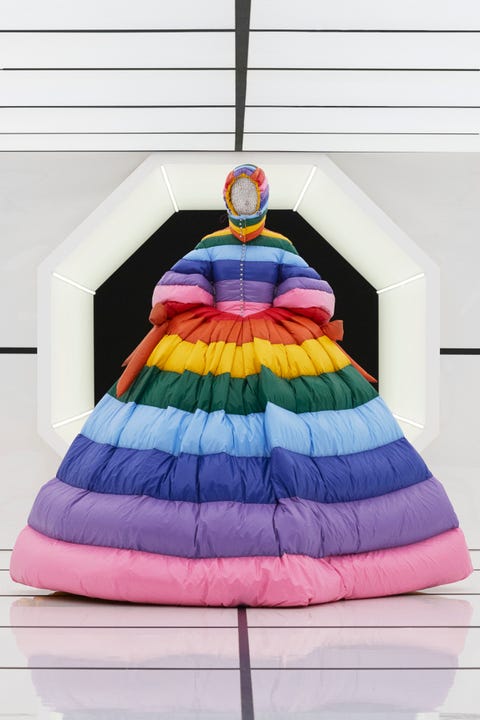
Richard Quinn looked to the Swinging Sixties for 8 Moncler Richard Quinn, his second collaboration with Moncler, available now. The London Fashion Week mainstay and Queen Elizabeth favorite designed a 32-piece collection replete with colorful florals, rainbow and zebra patterns, and and bejeweled and feathered embellishments. In addition to trapeze-style dresses and elegant pea coats that Jackie Kennedy might have worn, the lineup features a handful of impressive couture gowns with full opera skirts and Moncler's signature quilting.

Quinn tells CR he wanted to riff on the era's space-age fashion and referenced Stanley Kubrick's seminal 2001: A Space Odyssey. But his main inspiration? Twiggy. "I love Twiggy," he says. "I watched a lot of old videos from shoots she was on; I loved those super short but really chic dresses she used to wear. Being British, she's definitely [one of my favorite] style icons from the '60s."


Materials include nylon laqué, which Quinn calls "a kind of like shine-through nylon," faux fur, ostrich feathers, duchesse, and nylon twill. "I come from a textile background," Quinn says, "so I've always loved working with different materials. What's amazing about Moncler is that you can achieve such big volumes but the gowns and the jackets themselves are fairly light. It’s like taking their traditional house fabrics and then turning them into different things. Breathing new life to them."

The collection is a departure from Quinn's first collection with Moncler for the Fall/Winter 2019 season, which was featured in CR Fashion Book Issue 15 and was shown on Carine's first-ever catwalk last year. The ski helmets, tight body suits, and windbreakers that might've appealed to a younger demographic have been replaced with elaborate statement pieces, right down to the feathered baklavas and embellished pumps. Quinn's favorite from this season: the quilted pieces. "We’ve done [a piece] with big green, white, and yellow daisy prints; it almost looks 3-D."


The capsule is part of the Moncler Genius project, now in its third edition. In addition to Quinn, the brand has tapped everyone from Simone Rocha and Craig Green to JW Anderson and Valentino's Pierpaolo Piccioli. "It’s a nice fresh and new way of working," Quinn says. "No idea is too big—[Moncler] wants to push the idea as big as it can go. And what's best is they’re not afraid to do the really wild pieces."

Princess Grace’s Granddaughter Has Her Own Fashion Label

Think of the queens and princesses of Europe and modest skirt suits with matching pumps come to mind, but there are royal rule breakers. Grace Kelly, the actress turned Princess of Monaco, brought high-wattage Hollywood fashion to the throne. Her daughter, Princess Stéphanie, is beloved by contemporary designers for her ’80s-era statement jewelry and cutout minidresses. The House of Grimaldi is not short on extremely stylish women; now, one of the youngest members of the family is making her mark.

Pauline Ducruet—Stéphanie’s daughter and Grace’s granddaughter—soft-launched her fashion label Alter last year. A graduate of Parsons in New York, she put on her second official Paris Fashion Week show this March, just weeks before the COVID-19 pandemic forced France and countries around the world into lockdown. Ducruet’s designs are minimal, almost genderless. Her latest collection includes silk shirtdresses with matching trench coats and deconstructed denim and patchwork jean jackets, most of which she makes using upcycled and vintage fabrics. The ethos of the label, she says, is based on “the idea of alternating pieces already in our closets, updating staple items like leather and jean jackets, simple shirts. It’s also about the idea of equality between sexes and playing up alter egos.”


Ducruet is inspired by various forms of modernist architecture, as well as the women in her family. “My mom always pushed me to express myself and to be myself,” she says, “and that freedom is what has inspired me most.” Well, that and the hand-me-downs. The designer has inherited a cherished leather Harley-Davidson jacket from her mother and a sleek beige Givenchy coat that once belonged to her grandmother.

While isolating with her family in Monaco, Ducruet has been hard at work figuring out new ways to move her young brand forward. “It’s been difficult as a new label to stay positive about the future of the fashion industry,” she says, but she’s doing so by working on her next collection and staying focused on Alter’s core values of gender diversity, sustainability, and slow fashion practices. Call it a more progressive royal style for a new generation.

New Book Celebrates Seven Decades Of Dior Hats

Maria Grazia Chiuri has rarely met a hat she didn’t like. In fact, one of the signatures of the designer’s tenure at Dior is her habit of showing headgear with almost every women’s look — in the process giving the category a robust sales boost. Her vision has benefited from Dior’s ongoing relationship with Stephen Jones, milliner to the French fashion house since 1996 and a connoisseur of the brand’s archival treasures, which he has helped to compile into a new book, “Dior Hats,” published by Rizzoli New York.

The book features creations from all the house’s artistic directors, from Christian Dior himself through to Yves Saint Laurent, Marc Bohan, Gianfranco Ferré, John Galliano, Raf Simons and now Chiuri, who has revived the veiled beret as a marker of French chic. “Fashion is not just about clothes, far from it. Fashion is about building an identity, and this happens through clothes but also with accessories that can become a recognizable sign, a signature,” Chiuri told WWD.

“I love hats, and I think that what we wear on our heads is very important, because it showcases our facial expression, it sets off the look in someone’s eyes. We can hide behind and protect ourselves with hats, but they also allow us to reveal ourselves in an instant,” she continued. “Hats are the final touch that completes a look and draws attention to the face, setting the overall tone. That is why I want hats to always be a recognizable part of my collections,” the designer explained.


Her opinion dovetails with that of the house’s founder, who featured hats in every one of his 22 collections from 1947 to 1957. “It’s the best way to express your personality,” Dior wrote of his favorite accessory. The Rizzoli book, which comes out on June 3, was originally designed to coincide with an exhibition on the same theme at the Christian Dior Museum in Granville, Normandy, also under the artistic direction of Jones, who has also worked with brands including Marc Jacobs, Moschino and Thom Browne.

“Chapeaux Dior! The Art of the Hat from Christian Dior to Stephen Jones” was scheduled to run from April 25 to Nov. 1, but has been postponed indefinitely due to the coronavirus outbreak. The exhibition will feature around 200 hats alongside some 30 haute couture dresses, including the gray suit and pillbox hat worn by Carla Bruni-Sarkozy for her visit to London in March 2008 as France’s first lady. Jones also plans to re-create three hats designed by Dior in the Thirties, before the couturier launched his namesake fashion house.

In the meantime, hat aficionados can browse through the 240-page coffee table tome, which features a series of exclusive, never-before-published photographs by Sølve Sundsbø, alongside archival images by great image-makers including Bert Stern, Richard Avedon and Irving Penn. Chiuri has had a particularly productive relationship with Jones, producing memorable looks, including a butterfly-shaped pleated tulle mask inspired by Peggy Guggenheim for her Surrealism-tinged spring-summer 2018 haute couture collection.


“Stephen is a master. He knows his craft inside and out and he loves fashion; he knows its history and its cultural significance. We wasted no time getting down to business, and working with him has helped me tremendously in understanding the ins and outs of the house of Dior,” she said. “We still work together as equals, and at the heart of our relationship lie mutual respect and admiration,” Chiuri added. “He manages to interpret my ideas every time, vindicating the faith I have in his vision and creating headpieces that capture perfectly the spirit of the collection.”

The Italian designer, who started out designing handbags and other accessories at Fendi and Valentino, is particularly sensitive to the impact of the category. “Accessories have consistently gained ground in terms of status, taking on a specific identity and, in the most extreme cases, becoming icons. That’s why designing them is so complex. Accessories must reach a large audience, they must speak to different people and remain faithful to the original idea that conceived them, even if they come in a myriad of forms,” she mused.

“They are a challenge that requires great technical skills, and a dose of courage to be able to take risks and find new and interesting solutions. Moreover, taking accessories into account is necessarily a part of the process of designing a solid and coherent whole; it’s fundamental for creating a collection that is at once precise and readily understandable,” Chiuri said.