Tuesday, August 14, 2018

Telfar Present A New Perspective On Inclusive Fashion: Closing The Doors

August is notoriously fashion’s sleepiest month: a time when Instagram is overtaken by shots of Ibiza jaunts and trips to Deia rather than breaking news. That is, unless you’re Telfar, the idiosyncratic New York-based brand who have never done anything by the book. On Friday night, in lieu of staging scenic holiday snaps, designer Telfar Clemens and creative director Babak Radboy took the opportunity of Serpentine Galleries’ annual Park Nights programme to present a preview of their spring/summer 2019 collection, by way of a choral performance by South African collective FAKA held within Frida Escobedo’s recently-erected Pavilion.

Dressed in Telfar’s new season designs, FAKA's Fela Gucci and Desire Marea – accompanied by a line-up of their London peers – presented a haunting, acapella performance as the sun set in Hyde Park, which the audience were invited to view through the woven concrete walls. “We hate the idea that ‘we’re performing for you,’” explained Telfar. “No – you wanna see this performance, so let’s change the narrative.” Hordes of Londoners silently pressed their faces up against the confines to watch the movements of the dancers, wearing Telfar’s crisp-cut denim and jersey athleisure, first jostling for prime position before eventually calming down to let others move forward.

In situ, not only was the performance a remarkable spectacle but equally a curiously anthropological exercise; there was something about FAKA’s soothing harmonies, about the performers’ beautifully serene interactions within the Pavilion, that appeared conducive to a natural democracy. Nobody was pushing each other out of the way; people kept checking that the strangers alongside them had found a good spot. “Music is a collective thing that is part of everybody,” explained Babak. “It’s a useful tool for affecting human beings.” Occasionally, someone with a hand-held camera would pop up alongside you: it turns out the audience, too, will be part of the video of the evening captured by London-based filmmaker Akinola Davies. “You’ve been choreographed into a larger performance,” Babak said. “It’s no longer about that division. Your body is part of it; you’re not just watching.”
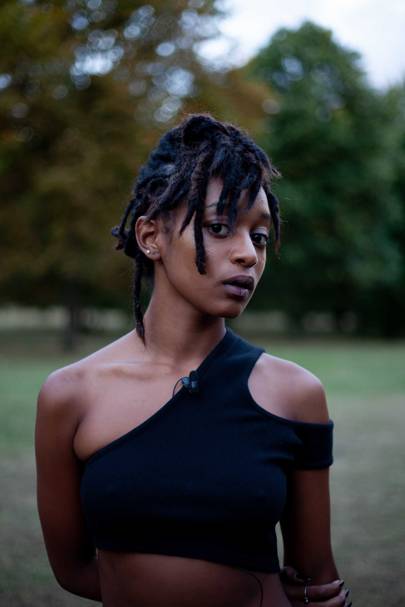

Telfar have long been celebrated for their inclusive, genderless approach to fashion which, despite winning them a CFDA Award last year, has routinely subverted the traditional system: last season, they presented their collection as part of a concert fronted by the likes of Dev Hynes, Selah Marley and Kelsey Lu; later, their Instagram followers were invited to vote on which garments were put into production (“We want to democratize fashion by letting YOU VOTE on the clothes,” they said. “SHOW STORES WHAT’S COOL”). “That’s what we’re trying to segue into… we’d love to eventually leave the fashion system as it is, and just make a collection that’s part of a piece of music, and go on tour with it," said Babak. “Fashion has rules and ways of going about things that people have long set in stone,” continues Telfar, “and I hate that.”

But now that exploring non-binary and marginalised spaces and communities has become ever so trendy, their disruptive spirit has proven newly magnetic (it is worth noting that Telfar has been running since 2005; while they might be one of the brands of the moment, they have been 13 years in the business). Accordingly, the performance was entitled "Not For You, For Everyone" because, “after the attention of the CFDA Awards, the closed doors [of the Pavilion] were like a metaphor for a space we’re trying to create,” explained Babak. “People keep trying to put these easy-to-digest labels on us: inclusive, diverse, whatever… we feel like people are putting a narrative on us so that it looks like they’re doing something awesome and everyone can feel fabulous.” It’s a fair point to make – until there is systemic change, bandying buzzwords about feels fairly louche – but if the success of Friday night, held in the middle of summer, inside a closed Pavilion, is anything to go by, then they’re going to struggle to keep the industry out.

What Are Serena Williams And Virgil Abloh Up To?

Virgil Abloh, the man with a near-impossible number of strings to his bow, took to Instagram last night to announce his latest project: “QUEEN” to Off-White’s 4.4 million followers.

The post, which features Off-White’s signature text overlaid on a Nike Swoosh, reads: "Virgil Abloh for Serena Williams 'QUEEN'", and is, quite simply, captioned with the tennis ball emoji in quotation marks.

Cryptic? Not enough to outsmart the legions of Abloh fans, who live for the thrill of unannounced street and sportswear drops such as these. The fact that the NikeCourt account, which is dedicated to tennis performance wear, had been tagged was quickly identified, as well as the date of the post. The Off-White x Nike x Serena Williams announcement hit feeds two weeks before the beginning of the US Open on August 27 – just enough time for the hype to reach fever pitch for Williams’s court-side debut of the product.

And so, the day after setting Instagram alight, Nike sent out a press release confirming the union of "two transcendent figures – Serena Williams and Virgil Abloh – who find common ground in pushing boundaries and inspiring youth". The "look" that Williams will premiere at Flushing Meadows consists of a black one-shouldered dress with full tulle skirt, a pair of customised Nike Court Flare sneakers and an off-court jacket. Iterations of each, including the below lilac dress, will be available to purchase at select Nike stores worldwide at the end of August.


"What I love about tennis is the gracefulness. It's an aggressive and powerful game, but it takes touch and finesse," Abloh comments on Nike's in-house newswire. “So the dress is feminine, but combines her aggression. It's partially revealing. It's asymmetrical. It has a sort of ballerina-esque silhouette to symbolise her grace. It's not about bells and whistles and tricks. It's just about it living on the body, and expressing Serena’s spirit with each swing of the racket."

Abloh has a comprehensive knowledge of Nike’s archive, after he reimagined 10 trainers from the core brand, and Nike-owned brands Converse and Jordan, in 2017. At the time, the designer said of “The Ten” project: “It’s larger than design culture. These 10 shoes have broken barriers in performance and style. To me, they are on the same level as a sculpture of David or the Mona.”

Williams’s relationship with the sportswear giant goes back 15 years. In 2003, Nike signed the then 22-year-old tennis champion to an endorsement deal that made her one of the world's highest-paid female athletes. The contract simultaneously bolstered the brand's presence in the women’s sportswear market and Williams’s personal brand away off the court. The “QUEEN” trainer style is the latest step in this mutually-beneficial journey.

Diesel’s Autumn/Winter 2018 Collection Sheds A New Light On 1990s Hedonism

There’s a hedonistic spirit to Diesel’s autumn/winter 2018 collection, ‘Stranger and Stronger’, which blends messages of youth and unity with references to fictional 1990s subcultures. Consider it a love letter to London’s bygone late-night scenes. Woven into the sporty silhouettes, grainy denim, and comic-book graphics are hints to the underground styling tricks that once identified British ravers in fields around the M25 orbital, or the cyber-goths who bathed in the neon glow of Electrowerkz’s Slimelight. This was where industrial metalheads collided with club culture; where late nights blurred into morning and fashion potentially offered a passport into a new nocturnal realm.

Hedonism for London’s next generation – here, creative consultant Zaina Miuccia and band manager Basti Robert - carries a powerful sentiment: the belief that shared ideas and real-time action can bring about positive change.“I started out by selling liquorice at music festivals. I now work tirelessly to create a space where musicians can be themselves.”


Miuccia’s style story has taken her to London by way of Lagos and Paris, where she is surrounded by the photographers and designers who document and design for the stars of a new underground world. Today her petite frame is swathed in ripped and repaired denim, a pair of metallic cowgirl boots hinting at mischief. She’s chatting animatedly about an upcoming trip to Jamaica, “but maybe France first”. There’s an iconoclastic edge to her fashion sense that defines a modern mood of fearlessness and freedom - a female force who generates change without necessarily being aware of it. How important is her power to move freely from city to city and project to project? “Vital,” she says, adjusting the exaggerated sleeves of an eye-popping fuchsia knit.

Both figures see their networks as central to their creative momentum: “Change starts from the people around you,” Robert adds. “I find inspiration with them to set about doing something that brings the light in.”

Thursday, August 9, 2018

Selfridges Opens The Largest Eyewear Department In The UK

At a secret location, somewhere in Sweden, the eyewear designer Anna Karin Karlsson, (known for her highly decorative 18-carat gold specs bedazzled with real pearls and gems) has embarked on a very special mission with one of her top clients. "I do personal eyewear styling," she explains. Personal what? It involves going through her client's extensive closets and selecting eyewear to go with each look. If she can't find the right style, Karlsson designs something bespoke.

Employing a personal eyewear stylist may be pushing into Elton John territory in terms of extravagance (and fabulosity) but it reflects the importance eyewear now has in the fashion firmament. No longer an afterthought, it's now a key part of your look. "You don't just wear one pair of glasses anymore - you need a wardrobe of glasses," says Eleanor Robinson, director of accessories and eyewear at Selfridges. Today, the store opened the biggest eyewear department in the UK; 300 square metres devoted to sunnies and opticals (2,000 different styles from 43 brands) in the centre of its vast accessories hall (also the biggest in the world).

"Optical on the ground floor in a luxury fashion environment is quite unique but we believe optical glasses are a luxury fashion accessory just the same as a handbag or a pair of earrings," says Robinson. The major fashion tipping point has been Gucci giving eyewear pride of place on its runways, followed by major sunglasses moments on the catwalks at Prada (narrow Matrix-style shades) and Loewe (oversized retro-future visor styles).


Also ushering in a new high-fashion approach to specs are influential models Bella and Gigi Hadid (whose collection of on-trend narrow cat-eye styles for the eyewear brand Vogue is stocked in the new space) and the blogger Chiara Ferragni who regularly sports frames by Gucci, Fendi and Dior. "This generation are taking pictures of themselves all the time and sharing them. Different glasses give you a different look and give you something fresh immediately. It's your number one selfie accessory," says Robinson.

Selfridges has plenty of big brands including Ray-Ban, Le Specs and Chanel(which, for the first time, will be selling Chanel-branded optical lenses in Selfridges) but just as in fashion a wave of independent niche labels has brought disruption, excitement and plenty of innovation to the eyewear arena. Out in front is Gentle Monster, the cult Korean brand known for its devotion to "weird beauty" and distinctive two-tone lenses. They come with a health and safety warning (don’t drive in them). In just seven years it has grown to a $200 million brand.

As well as a shift in fashion attitudes, Selfridges expects to cash in on the increasing myopia of millennials and Generation Z whose eyesight is considerably worse than previous generations thanks to their addiction to screens. "Younger customers are clued into it," says Robinson who notes that the first entry point into luxury brands for so many people is eyewear. "Perhaps they can't afford a bag but they will buy into sunglasses. People will always want a pair of designer glasses - that's just the way of the world."

Counterfeit Nike Air Jordans Ring Worth $73 million Shut Down

Five people have been charged in New York with trafficking in counterfeit Nike Air Jordans that, if authentic, would have been worth $73 million, according to the NYPD and Homeland Security Investigations.

Prosecutors say the group imported over 300,000 fake trainers from China before selling them across America. More than 42 containers labelled as generic shoes entered Port Newark between January 2016 and July 2018. Counterfeit Nike trademarked logos were attached to the trainers, including fake Air Jordan VIIs, Air Jordan XIs, and Air Jordan XIIIs, before they were shipped across the country.

“The five defendants in this case allegedly counterfeited over $70 million in fake Nike shoes and sold them to buyers on the US market,” Manhattan US attorney Geoffrey Berman said in a statement. “I commend our law enforcement partners for helping to bring today’s charges, which send a clear message to would-be counterfeiters: ‘Just don’t do it.’”


According to the International Trademark Association, $460 billion worth of counterfeit goods were bought and sold in 2016. Unsurprisingly, the internet, where it is easy to hide, is responsible for this booming business. Red Points, a brand-protection firm, found that six of the fake goods e-tailers had headquarters in the Far East, in particular China, and that shoes are the most common product subject to counterfeiting.

Designer brands, such as Salvatore Ferragamo have taken measures to avoid illegal online platforms forging ahead with selling fake Ferragamo goods, by inserting microchips and radio frequency identification tags into its shoes. However, it is expensive to guarantee product authenticity and facilitate the tracking of products, making it difficult for a global company like Nike to balance against the cost of Air Jordans, which retail for upwards of £70.

Rising Model Tess McMillan Needs To Be On Your Radar

I really, really wanted it,” Tess McMillan recalls of being an outsider looking in at the modelling industry a year ago. “But all I could think was, is it realistic? Is it something I can actually do?”

What started off as a longshot became a viable career because the Texas-born 17-year-old made it happen herself. She found a fashion photographer she could relate to on Instagram – Heather Hazzan – and asked her to share her portraits with New York agencies. Muse Management came calling, and McMillan says “she fell in love… the agents just had this energy”.

Her first job was promotional work for J. C. Penney’s Dallas outpost, shortly followed by an editorial in Barneys' in-house magazine, The Window. She felt like she’d hit the jackpot. “Growing up you see movies like The Devil Wears Prada, and you think, 'Gosh, people in the fashion industry are going to be super cold and mean'. But everyone has been so nice and welcoming.”

Now 18, McMillan has got passport stamps from Berlin (by way of Zalando) and London (courtesy of British Vogue’s Botticelli-esque September shoot styled by Poppy Kain and shot by Charlotte Wales). She has taken up permanent residence in Brooklyn after a brief stint in a “nun-hostel type situation” on the Upper East Side. “I’m not Catholic, but it was cheap accommodation for working women,” she explains. “I’d take the elevator up to my room after a modelling job and be surrounded by nuns standing in awkward silence.”


The last-minute lifestyle and sporadic scheduling suits her, as she admits to being “the kind of person who doesn’t tend to plan their life very well – I’m not a fan of routine.” Shows are not something she has considered (yet), because she gets stage fright. “It’s something I would need to get over in order to do runway,” she shares. “And I just love print modelling so much because it’s nice to see the finished product.”

A two-year acting course at the American Academy of Dramatic Arts will help iron out any nerves about performing in front of an audience. But don’t expect McMillan to promote her budding stage and cinema career. “I have a love/hate relationship with social media,” she sighs. “I like sharing things that are going on, but I get easily overwhelmed by it. I prefer to keep my Instagram personal.”

When asked who she looks up to in the industry, her answer is indicative of her down-to-earth attitude. The photographer who shot her Models.comportfolio - Franco Schicke - asked her for coffee beforehand in order to build up her confidence, and his manners shot him to the top of her role model list. And creatives, including the "amazing" team at British Vogue, are what will keep her boarding a plane to London at a moment’s notice despite her looming school schedule. “I just had the best time,” she says with a touch of that Texan twang coming through.

Browse the "Age of Opulence" shoot, with McMillan in richly coloured silks, cascading frills and stately silhouettes, and it's clear that behind her cherubic face, there is a model and actress with ambition. Prepare to see Tess McMillan everywhere.

Why Helmut Lang’s Reissued Bondage Pieces Are Just As Relevant Now

For the third volume of Helmut Lang’s Re-Edition series, a project that reissues important heritage items from the archive, implemented by editor-in-residence Isabella Burley, the brand is bringing back nine black bondage-inspired pieces.

To aid with the selection of items which would resonate best with a new generation of customers forming their own attachment to Helmut Lang, the brand enlisted Byronesque. Dealers from the vintage personal shopping app chose unisex clothing, including a split-hem tank, bomber jacket, printed T-shirt and Velcro bulletproof vest, all of which were originally released between 1994 and 2004.

“We started by looking at the specific requests we get in our app for vintage Helmut Lang,” Byronesque founder Gill Linton tells Vogue, upon the launch of the capsule. “But it was important to us that we made a statement with the collection, rather than put out a random selection of clothes.”

Since launching the online platform in 2013, Linton has come across many Lang fans. “They are some of the most ardent of all, even more so than Margiela followers and they’re passionately vocal about change,” she shares. “We became very aware that the time was right to celebrate Helmut himself and how he felt about culture and creativity.” Bryonesque’s research led them to the “now very relevant” quote seeded from an interview that Lang gave when he exited his namesake company in 2005: “It’s dangerous to become over-exposed.”


The words resonated because “Lang’s effortless minimalism is the antithesis of today’s Kardashian-infested culture,” Bryonesque creative director Justin Westover explains. “For some people the bondage collection reflects a time in fashion that was more exciting than it is today, particularly in New York,” Linton chimes back in. “Helmut was responsible for making NYC cool, and here we are again, when the city desperately needs it. But it’s not a collection based on nostalgia, it’s a collection of clothes that still feels new and exciting today.”

To continue the Helmut Lang narrative, Bryonesque created the idea of the brand “going dark” blacking out the stores and campaign imagery to let the reissued products speak for themselves. “We didn’t feel the need to add more to the current vanity-obsessed culture,” Westover asserts. “Even though Byronesque deals with vintage clothes, we behave like a contemporary brand with everything we do viewed through the lens of the culture of the time. There was always a darkness to Lang's bondage-inflected collections, which is evident in this re-edition.”

When nostalgia continues to be firmly entwined in the trend zeitgeist, Linton’s feeling that “the early 2000s was possibly the last era that fashion was really a creative business,” has filtered down to the consumer, too. “There’s a definite longing for clothes and brands that recreate that. We especially see it from younger people who weren’t part of Gang Lang the first time around.”