Thursday, December 28, 2017

Phoebe Philo To Leave Céline

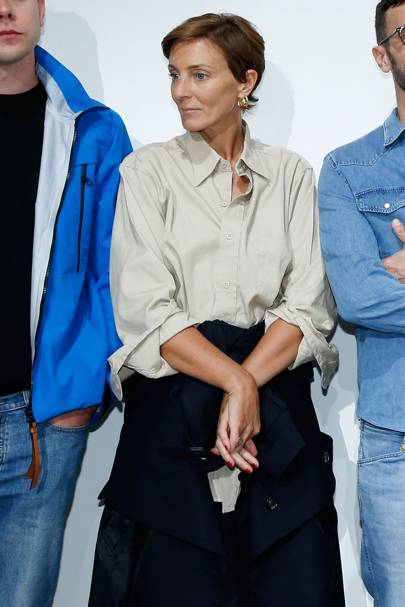
Phoebe Philo is to leave French fashion house Céline after 10 years as creative director. The autumn/winter 2018 collection, which will be presented at Paris Fashion Week in March 2018, will be the British designer's final collection for a brand she has transformed with her signature modernist style and sell-out accessories. Until a new creative director is named, WWD reports that the label’s collections will be designed by Céline's in-house design team.

Philo's departure comes after months of speculation that a move was in the works. In a statement she said: “Working with Céline has been an exceptional experience for me these last 10 years. I am grateful to have worked with an incredibly talented and committed team and I would like to thank everyone along the way who has been part of the collaborations and conversations. It’s been amazing.”

“What Phoebe has accomplished over the past 10 years represents a key chapter in the history of Céline. We are very grateful to Phoebe for having contributed to the great momentum of this Maison," said LVMH chairman and chief executive officer Bernard Arnault. "A new era of development for Céline will now start and I am extremely confident in the future success of this iconic Maison.”

Known in the industry as a bellwether of immaculate taste, Philo's minimal, discreetly luxurious aesthetic has legions of disciplines, the self-styled "Philo-philes", who wear her sharp-shouldered suiting and swing her block-colour bags from their elbows with singular pride. She joined Céline from Chloé in 2008, having taken a two-year maternity leave - a move that was itself highly unusual in an industry that rarely accommodates stoppage - and immediately set about revitalising a label that previously had very little personality, having been founded as a children's shoemaker by Céline Vipiana in 1945.

She enlisted the art director Peter Miles to reimagine the logo, inspired by a mid-20th-century Italian font found in an old type specimen book, and executed in a stark "left in the sun black" on creamy white. Juergen Teller was procured to shoot the ad campaigns, which have variously featured a make-up-free and knotty-haired Daria Werbowy, the French ballet dancer Marie-Agnès Gillot and the inimitable, 81-year-old Joan Didion (the internet imploded).


As for the wardrobe components, Philo, 44, made them in her image. Sharp, refined, discreet, new, were all buzzwords that she placed at the heart of the brand. Trench coats, suiting and black evening dresses - all cut just so, recognisable from thirty, forty, fifty feet away - made them manifest. She shies away from imposing abstract concepts on her collections, and from discussing them with the press - these are clothes for women with shit to get done, which includes their creative director - though this season made an exception backstage at her spring/summer 2018 show, telling Vogue: "I wanted it to look optimistic. It felt personal to me. I felt like celebration. If there is anything to say at the moment, let it be with love. Let it be joyful." For spring, she imagined the Seventies Céline woman, "this kind of Avenue Foch lady that I've always been intrigued by. The idea of that woman is one of the reasons why I wanted to work at Céline."

Exuberant sales reflect the esteem in which Philo is held with her customers. LVMH does not release individual figures of the brands in its stable, though its report for the first half of 2017 detailed that "Céline posted solid growth, buoyed by successes across all product categories. In leather goods, the Classic and Belt models performed especially well." Philo's skill with leather goods is virtually unsurpassed in the industry - as other brands struggle to create "it" bags, she churns them out with ease, as a glance through any selection of street style photography will prove. For a brand with such a modern aesthetic, it's perhaps confounding that its clothes are not available to buy online - though this is all part of the mystery in which Philo has enveloped the brand, not to mention herself. She rarely gives interviews and has no social media presence, once telling Vogue: "The chicest thing is when you don't exist on Google. God, I would love to be that person!"

Thanks to her impulse for discretion it will be hard to predict where Philo will go next - she's certainly giving nothing away. Philo's name is being mentioned, however, in connection with Burberry. Long rumoured to be the successor to Christopher Bailey, who stepped down after 17 years with the company in October, Philo has the English spirit and reinvention credentials to turn around a powerhouse whose gloss has started to rub off in recent years. Plus, it would mean a reunion with her former colleague of eight years Marco Gobbetti, now Burberry's CEO, who fuelled double-digit growth in partnership with Philo at the Paris house.

Either way, fashion-watchers will be heading to stores to snap up what's left of her Céline collections. Here's hoping the North Pole and its residents get the memo.

Friday, December 22, 2017

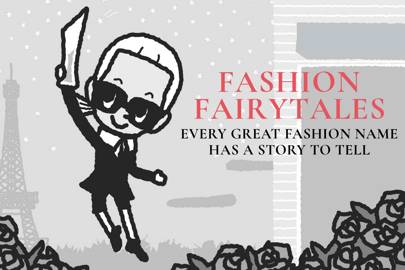
Karl Lagerfeld: Fashion’s Greatest Fairytale

Childrensalon.com and Vogue are pleased to present the first in a series of Fashion Fairytales, starring one of the greatest fashion names of all time
in partnership with Childrens Salon.


This isn’t a story just about one little boy from Germany. It’s actually a story about you and me, too. The little boy at the centre of the tale – Karl Lagerfeld - has a talent so powerful and so impressive, he was able to cast a spell over the way we dress and change what’s in our wardrobes forever. How does this fashion fairytale start? Once upon a time, of course.


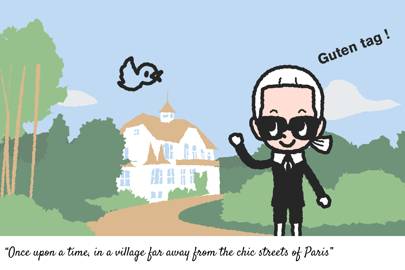
Once upon a time, in a village far, far away from the chic streets of Paris, lived a little boy and his family. Life in Northern Germany did not involve very much glamour. It was less couture, more cows.


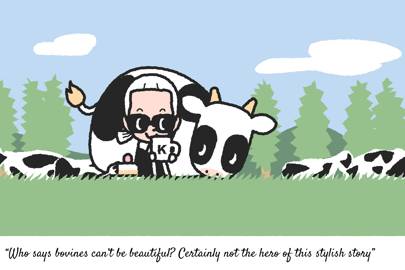
But who says bovines can’t be beautiful? Certainly not the hero of this stylish story. While his dad introduced Europe to a special sort of milk called Gloria that’s perfect for sweet treats, Karl came to love the black and white cows that surrounded him and was especially fond of one, Tecla.


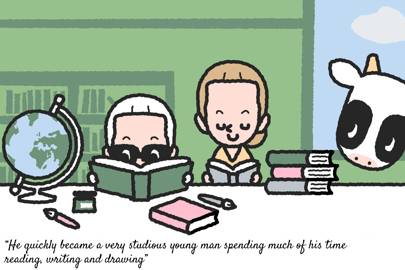
However, as Karl grew older he spent less and less time with his grass-eating friends. His parents were very, very clever and expected him to be just like them. He quickly became a studious young man, spending much of his time reading, writing and drawing. Every day from then on, Karl’s mother would insist he learn a page of the dictionary off by heart.


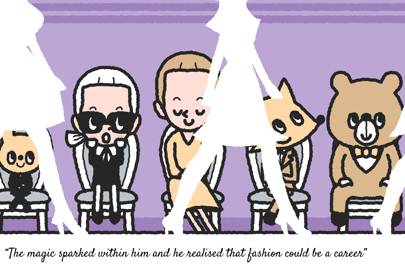
By now, you must be wondering how Karl came to love fashion if he always had his head in a book? It all started when he accompanied his stern but chic mother to a fashion show. The moment Karl saw the first model sashay down the catwalk, it all came together. The magic sparked within him and he realised that fashion could be a career. Karl continued to read books and study illustration magazines – valuable research for what would become his very own fashion designs.


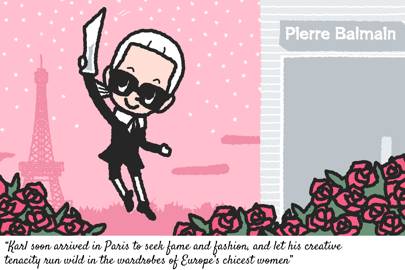
Returning to the countryside, Karl knew his time surrounded by his old friends the cows was over. Karl soon arrived in Paris to seek fame and fashion, and let his creative tenacity run wild in the wardrobes of Europe’s chicest women. Before long, Karl had won a competition for the best coat design in the whole of Paris, and people soon took notice. Pierre Balmain – an already famous and celebrated designer – made Karl his assistant.


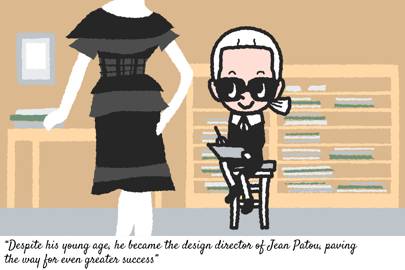
Even though he was still a young man, Karl left Balmain and made his very own fashion wishes come true by becoming the youngest design director of the chic French brand Jean Patou - paving the way for even greater future success for the hero of our story.


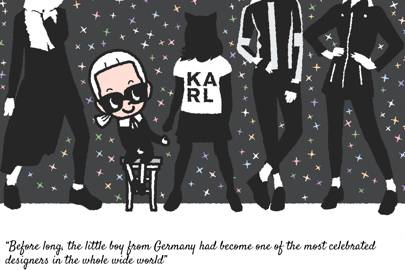
Before long, the little boy from Germany had become one of the most celebrated designers in the whole world and women from all over the globe were eager to wear his designs. Within a few years, Karl would be leading the way at major fashion houses Chloé, Fendi, Chanel and his own-name label, Karl Lagerfeld. However, what Karl began to realise was that while women were able to dress in his designs, it was not so easy for younger generations. Putting a stop to this, Karl expanded so that his clothes are available for all! If you look into your wardrobe today, can you find your own little piece of Karl Lagerfeld history?

Cultural Appropriation: Theft Or Innovation?

In the era of digital activism, fashion is no stranger to the “cultural appropriation” debate. In recent weeks, Chanel came under fire for a $1,325 branded take on the boomerang, a weapon used by Australia’s long-marginalised indigenous peoples for hunting before being widely adopted for sport and entertainment. Then, Gucci’s Alessandro Michele attracted charges that he was stealing from black creatives for the Dapper Dan-inspired looks that appeared in his 2018 cruise collection. But from Victoria’s Secret, which sent Karlie Kloss down the runway in a fringed bikini and feathered Native American headdress, to Marc Jacobs’ Spring 2017 show featuring a cast of mostly white models wearing dreadlocks, the phenomenon is hardly new.


On one side of the debate are those who see cultural appropriation, especially in a commercial context, like fashion, which values surface (and sales) over depth - as inherently disrespectful to the cultures that are so often sampled, but rarely credited and almost never compensated for the use of their heritage. On the other side, are those who see the freedom to fluidly sample from other cultures as vital to creative expression and cultural innovation, citing the fact that humans have been borrowing, even stealing, from each other’s cultures for thousands of years, much to the enrichment of human experience. But who’s right?

Chasing Lucky Blue Smith

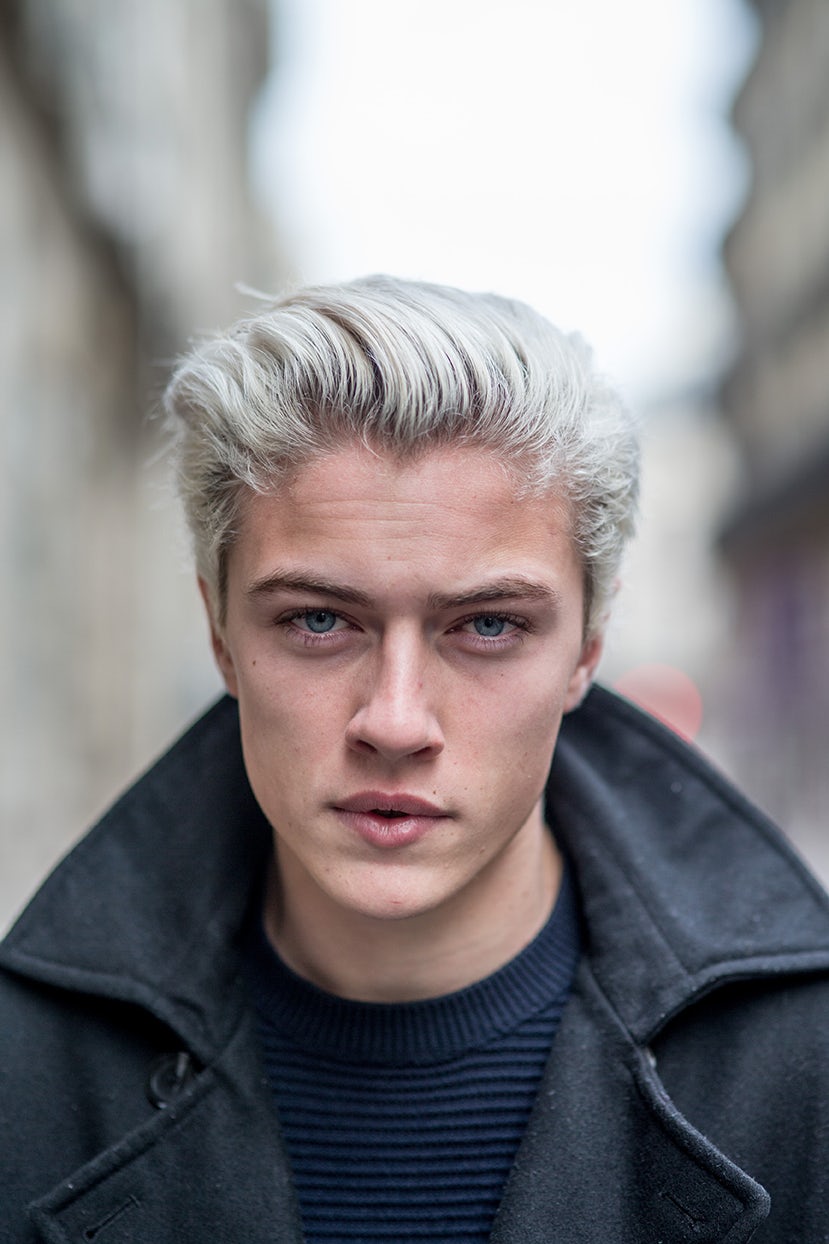
 Lucky Blue Smith, who has been compared to both River Phoenix and a young Brad Pitt, posts the Instagram photo at 12.15pm on Sunday from a small café near Colette in Paris’s 1st arrondissement: “PARIS Here is another chance to come say hi to me! Come meet at 4pm at the Fete Foraine du jardin Des Tuileries!! Come!!! I wanna meet you all.”

It’s 4.00pm and the 6’3” sixteen-year-old is walking down a one-way lane that connects Rue Saint-Honoré and Rue de Rivoli when the first fans notice him. They lead him across the street to the Tuileries entrance, where another six girls stand waiting, iPhones at the ready. They all start snapping photos. Inside the gates, four more girls are dancing from foot to foot and tugging each other’s sleeves. “C’est Lucky!” In the distance, from over by the ferris wheel, at least 40 girls can be seen sprinting in his direction. Passersby stop and stare. Many pull out their phones to snap the stampede. Lucky smiles and waves; relaxed, engaging and effortlessly charismatic amidst the chaos. And the fans just keep coming. There are now over 100 girls huddled in a massive circle around him. Lucky laughs as they touch his hair, kiss him on the cheek and grab him in places they probably shouldn’t.

As an ‘Insta-famous’ male model with about 285,000 followers on the popular image-sharing platform Instagram, you might not know him, but teenage girls most certainly do. His fans are diverse and global, but if there’s one thing they share, it’s a near obsession with Lucky Blue. While his follower count is well below the staggering 9.2 million users who follow Cara Delevingne on Instagram, Lucky Blue boasts some impressive engagement metrics. In the last 12 hours alone, his fans have tagged him in 223 photos, some of which are modeling shots; many of which are candid shots taken from his Instagram account; others are simply screengrabbed text messages between friends talking about how much they love him. On average, his Instagram posts are liked by about 30,000 to 40,000 people each, or about 10 to 15 percent of his total following on the platform, which is significantly higher than the average rate for fashion brands, which social media analytics firm Union Metrics puts at 4.3 percent.

And, like Delevingne, Lucky’s fans don’t just follow him online, but in real life, too. He’s the only 16-year-old boy on the international fashion scene who has the power to make people show up in the flesh when he posts on social media. And he’s not afraid to use this power.

“A ton of fans showed day,” said Lucky Blue’s mother, Sheridan Smith, referring to the stampede of teenage girls who greeted the model when he exited the building after walking in the Sacai men’s show on Saturday morning. “But he told them a whole day ahead of time.”

Over the past couple of months, the sight has become increasingly common. Lucky Blue, with his perfect skin, flashing teeth and shock of white hair, shows up in a new city where he’s been booked for a shoot or a show — and girls swarm. In London, there were 60 waiting with signs and posters at Heathrow Airport. In Amsterdam, 20 stormed the American Hotel where he was staying. In Milan, they lurked outside the Fendi show. This kind of following is unusual for a male model.

And yet nothing had prepared Lucky and his mother for what happened on Saturday in Paris. “The crowd of girls was so big on this small street that they were literally blocking traffic,” Sheridan says. “There must have been 75 of them. Two older girls took charge and led the fans through to an open square.”

This is Lucky’s freshman show season in Europe. In London he booked Tom Fordand Dunhill; in Milan he walked Etro, Philipp Plein, Bottega Veneta and Fendi; and in Paris he walked just one, Sacai. Saint Laurent has put him on hold every season since he was 14, but is yet to book him for a show.

Lucky’s biggest jobs to date include a CK One campaign shot by Mario Sorrenti, a Gap campaign and a Tommy Hilfiger campaign, featuring an ensemble cast of models, to be released this spring. Working with a range of prestigious brands has increased Lucky’s bankability and exposure. Meanwhile, for the brands that hire him, his social media profile can increase their visibility among a new generation of post-Internet consumers (Lucky was just five years old when Facebook was first launched) who are expected to hit their earning peak in 2020.

“Before I came to Italy, I’d never heard of most of these designers,” he says. The same is true of much of his audience. “I think I’d heard of Fendi and Gucci and that’s it. What’s that one I did? Botte… Venet or something? And Roberto Cavalli, I didn’t know either.” A photo he posted of himself on the catwalk at Roberto Cavalli garnered 30,464 likes and 599 comments.

“His fans love him,” says Sheridan. “He has about 20 fan-pages. The funny thing is, most of these kids don’t even know about his music. That’s the next step — I don’t think any young boy ever sees modeling as the end game. Wait till they see him playing drums.” Yes, he’s also a musician, and it’s a family affair.

Lucky Blue and his three older sisters — Pyper America, Daisy Clementine and Queen Starlie — are in a surf-rock band named The Atomics, which they started together several years ago.

“We’re working on our first album as a band,” he says. “It’s kinda crazy because right now I’m in Europe doing fashion week and my two sisters are in LA writing with our Dad and Pyper’s in New York for fashion week, but she’s recording her harmonies over there and sending them through, then I’m flying to New York for fashion week, too.”

Pyper and Daisy, standing at 5’10” and 5’10.5, respectively, both model too. Queen Starlie (just Starlie to her family), at 5’3”, is too short to model. “She’s fun-sized,” says Sheridan. “But she’s lead singer of the band.”

Lucky Blue was 10 when his older sister Daisy Clementine was discovered by a model scout in Utah and sent to Next Models Los Angeles. Alexis, the director of the agency, asked Lucky to come back in a couple of years. Two years later, on a family road trip to California, they stopped by Next and the whole Smith clan was signed on the spot. “We kept getting called back,” says Lucky. “Next were setting up all these meetings with people about reality TV shows and Nickelodeon shows, but I just wanted to go to the beach.” A few days later they did their first shoot together as siblings and as a band. The photographer was Hedi Slimane and the photos appeared in Vogue Homme Japan. The Smiths relocated to Los Angeles soon after.

“Acting, modeling, music, we’re trying it all,” says Lucky. He’s about to start work on an indie movie directed by a family friend named Rob Diamond. It’s a love story written specifically for Lucky. His dream co-star? “Candice Swanepoel. She’s so hot.”


For the moment, money is tight. The six Smiths live on Hollywood Boulevard, near the Chinese Mann Theatre, in a two-bedroom apartment. The parents are in one room, the four siblings in another. “It was a family decision to move to California from Utah,” says Sheridan. “It hasn’t been easy, but if one of us succeeds, we all succeed. We’re all working together to try and make this happen.” Is she a ‘momager’? She laughs. “I don’t like that word, but I do like to support and empower my children.”

The moment they arrived in LA, the kids, who are home-schooled, were introduced to a crew of Internet-famous teenagers who hang out together regularly and post pictures of their adventures. “Some have, like, 532,000 followers on Instagram,” says Lucky, “and others have like 2 million. They’d post pictures with me and I got like 50,000 followers straight away. Once I got up to like 110,000 it grew on its own. I’m getting like a thousand to two thousand [new followers] every day.”

Unlike traditional celebrities who protect their private lives, many Internet-famous kids, like Lucky, are endlessly open and accessible and want to interact with their fans — within reason. “I get about 150 direct messages a day on Instagram,” he says. All from girls. He doesn’t open them. “I don’t want to disappoint them by not replying,” he says, “But if I did reply to all of them I’d never have time for anything else.” As a Mormon, he’s also planning on abstaining from sex until he’s married.

Lucky says he’s equal parts thankful for, empathetic towards, and confused by his fans. He repeatedly stresses that he doesn’t want to let them down and also that he’s not entirely sure what has made him so popular.

“I don’t want to be one of those kids who gets famous and then changes and becomes cocky. That’s why it’s so important to me to try and take a photo with every girl who comes to see me. I don’t really get why they seem to like me so much, but if I can make them feel happy by sticking around and that makes their day better, then what’s an extra 30 minutes to me? What else am I going to be doing?”

Back in the Tuileries, a girl is slumped against a wall, heaving breaths and crying uncontrollably. When Lucky sees her, he asks everyone to move aside to allow him to go and talk to her. He and Sheridan crouch down next to her. He holds her hand as she looks up at him and smiles and cries. She’s so overwhelmed she can hardly talk, but she hugs him for 15 seconds and kisses him on the cheek before letting go. The moment he turns and walks away, she faints cold on the wet ground. The police run over. “This is finished!” they shout in French. “Please exit the Tuileries!”

We hustle him through the crowd and flag a cab on Rue de Rivoli. The girls beg him to stay. “Please Lucky! One more photo!” He sits in the front seat, winds down the window and tells the driver to wait so a zealous crew of three who’ve stopped oncoming traffic, can poke their heads in for a final shot. As we pull away, he slumps back in his seat. “Wow, that was way bigger than yesterday. I used to think my friends in LA who do organised meet-and-greets with security guards were just being cocky, but now I think I get it.”

He stops talking for a moment, so he can reply to a direct message sent from one of the girls who had just showed up in the Tuileries. She runs the fan page @luckysfacts and he's thanking her for coming. “That was kinda crazy.”

From Gucci To Calvin Klein, Where Top Fashion Brands Recruit

Want to work at Tommy Hilfiger’s design headquarters in Amsterdam? Consider applying to Kingston University. Its students have collaborated on projects with the PVH-owned brand. Passionate about tailoring? Brioni, the menswear house owned by Kering, partners with London’s Royal College of Art each school year to hold talent competitions and recruit interns.

Gone are the days of the shot-in-the-dark application. In order to burnish their reputations as employers and recruit top talent, leading luxury houses are developing formal programmes with the best universities. These feeder programmes — from Kering’s partnership with the Centre for Sustainable Fashion (CSF) at the London College of Fashion to Sup de Luxe at Paris’ École des Dirigeants et des Créateurs d'entreprise (ECF), which offers both a master’s and bachelor’s degree in global luxury management and is supported financially by Richemont-owned Cartier — are now often the key to landing an entry-level position at a top fashion company.

“It’s more about partnerships these days,” says Karen Harvey, an executive recruiter who places c-level candidates in positions on both the creative and business sides of fashion. “Through these long-term relationships, companies get to meet with the students more than once or twice. It’s not just about glancing through their portfolios.”

But which schools offer opportunities at which brands? BoF examined three of the industry’s top conglomerates to identify both formal and informal partnerships between their labels and the world’s leading fashion schools.


Kering

Top Brands: Gucci, Saint Laurent, Bottega Veneta, Balenciaga, Stella McCartney, Alexander McQueen, Brioni.

Kering’s formal programmes with universities span both disciplines and regions. "A key objective of the group is to attract, recruit and develop the best people for every aspect of our activities, wherever they may be," a spokesperson for the group told BoF. "We want to create an environment where each of us is encouraged to learn, to grow, to fulfil our potential and to have a positive impact. Diversity in the workplace — of gender, nationality, age, background, sexual orientation and talent — enriches us all and is a key driver of creativity and growth."

For MBAs, the luxury group sponsors the “Kering Luxury Certificate” at international business school HEC in Paris. The programme includes seminars led by Kering managers and visits to Kering brands, as well as an annual competition judged by HEC professors and Kering directors. In 2017, 38 participants from 15 different countries were admitted into the programme, which, according to Kering, regularly results in appointments within the group.

On the creative side, Kering participates in several initiatives, including its partnership with the London College of Fashion’s Centre for Sustainable Fashion (CSF), which includes a master’s course in sustainability supported by the company as well as the annual Kering Award for Sustainable Fashion — a monetary prize and/or an internship placement — and an annual talk given by a Kering executive. (At this year’s talk in October, Gucci chief executive Marco Bizzarriannounced that the white-hot brand would no longer use real fur in its clothing and accessories.)

At Parsons School of Design in New York, Kering awards two BFA fashion design graduates the opportunity to intern or apprentice at one of its brands, while its partnership with the University of Tsinghua in Beijing includes two programmes: the artistic innovation studio, which helps students create their own workspace, and a scheme that offers financial support to 10 female students.

There are also more specialised programmes within Kering’s brands, including a partnership between La Scuola dei Maestri Pellettieri, Bottega Veneta’s workshop, and University IUAV of Venice, which offers post-graduate training in creating handbags and other accessories. At Brioni, tailors are trained through its own sewing school — Scuola di Alta Sartoria — while other talent is tapped through the Royal College of Art, where the brand supports competitions and recruits interns. Gucci recently partnered with Italian fashion school Polimoda to launch a master's course in fashion retail management.

LVMH

Top brands: Louis Vuitton, Céline, Givenchy, Dior, Loewe, Marc Jacobs.

With more than 70 maisons under its umbrella, it’s no surprise that LVMH’s formalised partnerships are quite varied. While the company recruits from traditional design schools including Institut Français de la Mode, Central Saint Martins and Parsons School of Design, it also looks to Harvard Business School, INSEAD and HEC to hire MBAs.

At ESSEC business school outside of Paris, students can be selected for the LVMH chair, a luxury brand-management programme with seminars led by LVMH managers, complemented by company visits and internships. Students also get to work on a real-life project with an LVMH brand manager. LVMH and Dom Pérignon also support ESSEC’s “Savoir-Faire d’exception” chair, a 20-student course that explores the importance of heritage in the luxury industry.

At HEC Paris, LVMH supports a chair in general management in excellence and client experience. Prospective students interested in supply chain and logistics might look to engineering university CentraleSupélec, where the group backs a course on the topic. Milan’s Bocconi University has established a fashion and luxury management professorship in partnership with LVMH, which also supports the luxury track of its MBA programme. In Asia, the conglomerate has teamed with Singapore Management University on a research initiative that aims to shed light on the luxury goods market in the East through unbiased case studies and field reporting.

On the design and creative side, LVMH often recruits interns and entry-level designers from Central Saint Martins as well as Parsons School of Design. In 2016, the group launched "Sustainability and Innovation in Luxury," a strategic partnership with Central Saint Martins to identify "cutting-edge solutions to address future sustainability and innovation in luxury." LMVH also offers vocational training through its Institut des Métiers d’Excellence (IME).

For Burak Cakmak, dean of fashion at Parsons, formalised partnerships are not only about work placement, but also about résumé building.

"The immediate benefit for a brand is the ability to learn from the talent and to be able to hire the individual," Cakmak says. "But it will always be a small number of students who achieve that. No matter if you are directly hired, what matters is what you have on your CV and diversity is critical."

PVH

Top brands: Calvin Klein, Tommy Hilfiger.

The New York-based group welcomes 300 to 350 summer interns into its 10-week programme. And that’s not including those placed in its offices in Europe. (PVH hires 20-25 percent of its interns each year.) “They do real work,” says Dave Kozel, executive vice president and chief human resources officer at PVH. At Calvin Klein, 50 new interns are welcomed each semester.

PVH has working relationships with more than 250 schools globally. While many senior executives graduated from schools located on the east coast of the United States — including the Fashion Institute of Technology, Philadelphia Universityand the Savannah College of Art and Design — certain schools are pinpointed for certain skills.

For instance, Lehigh University and Penn State University, both in Pennsylvania, often breed good candidates for supply-chain related jobs, while the University of Delaware boasts a strong fashion-merchandising programme. Parsons and FIT are the primary feeders for entry-level design positions. In Europe, PVH regularly works with the London College of Fashion and Kingston University, as well as Hong Kong University in Asia.

Rendez-Vogue: Amber Valletta

In a new era of superstar models keen to use their platforms for activism, Amber Valletta stands out as the first supermodel to break that glass ceiling. Once again a fixture on the runway – and current face of Mercedes-Benz – she tells Vogue fashion critic Anders Christian Madsen about her fight for sustainability and her political ambitions.

The day before Donatella Versace would reunite four of the original supermodels on her September runway, I am at the Baglioni in Milan having lunch with another member of that exclusive club. Amber Valletta, of course, already walked Versace last season. The week after, in March, she led an ensemble cast of models from the 1990s down Dries Van Noten’s catwalk to mark his 100th show, fronting a new wave in fashion where models are once again encouraged to be more than just mannequins. “I wouldn’t normally be running around with a bunch of 20 year olds trying to get into every fashion show, but everything I did last season was appropriate,” Valletta asserts. At 43, age-appropriate is hardly something she needs to be concerned about. Fair-skinned, blonde and built like a racehorse, she somehow fuses grace, sophistication and sex appeal in one all-American package, dressed head-to-toe in sparkly Isabel Marant, whose show she also walked last season. “You can wear glitter in Milan in the day,” as she points out. When Valletta returned to modelling a few years ago following a break to focus on her acting career, you couldn’t call it a comeback. Much like her famous peers, from Christy Turlington to Lauren Hutton – both of whom she name-checks – it runs through her veins. “It’s like a classic automobile, or a house like Chanel: those things don’t go out of style,” Valletta quips."Would she run for office herself? 'Yes, but I’m not sure anybody would listen. I definitely thought about it.'"

The day before Donatella Versace would reunite four of the original supermodels on her September runway, I am at the Baglioni in Milan having lunch with another member of that exclusive club. Amber Valletta, of course, already walked Versace last season. The week after, in March, she led an ensemble cast of models from the 1990s down Dries Van Noten’s catwalk to mark his 100th show, fronting a new wave in fashion where models are once again encouraged to be more than just mannequins. “I wouldn’t normally be running around with a bunch of 20 year olds trying to get into every fashion show, but everything I did last season was appropriate,” Valletta asserts. At 43, age-appropriate is hardly something she needs to be concerned about. Fair-skinned, blonde and built like a racehorse, she somehow fuses grace, sophistication and sex appeal in one all-American package, dressed head-to-toe in sparkly Isabel Marant, whose show she also walked last season. “You can wear glitter in Milan in the day,” as she points out. When Valletta returned to modelling a few years ago following a break to focus on her acting career, you couldn’t call it a comeback. Much like her famous peers, from Christy Turlington to Lauren Hutton – both of whom she name-checks – it runs through her veins. “It’s like a classic automobile, or a house like Chanel: those things don’t go out of style,” Valletta quips."Would she run for office herself? 'Yes, but I’m not sure anybody would listen. I definitely thought about it.'"

Whereas the new generation of household name models are largely children of celebrities with a knack for social media, supermodels like Valletta were created out of nowhere. “I do think we felt like there was more character then, because there was. There was only, let’s say, 50 girls who were working all the time, and then you had the top 20. I think there was more character because there was more time to develop these women, but it was also that you didn’t see them on a constant basis,” she points out. “That’s one of the problems with social media: there’s no mystery left in anything. It definitely affects how we feel about people, because you see these kids don’t have much going on except for selfies and going to parties or whatever. It doesn’t feel like the life experience is there, even though it might be.” With an Instagram following of 312,000, Valletta isn’t a stranger to social media, but contrary to the new generation of models, she limits her activity to work. “Listen,” she says, “those girls are hard workers and all that social media stuff is a talent in itself. I’m obliged to do it for work, but if I wasn’t obliged, would I do it?” As you’ll quickly come to realise, Amber Valletta isn’t one for fluff. A wild child in the 1990s, she’s been sober for nearly 20 years and has devoted her spotlight to the struggle for sustainability in the fashion industry and beyond.


This season, she and her 6’5 tall, 17-year-old model son Auden McCaw – whose father Chip McCaw Valletta divorced in 2014 – feature in Mercedes-Benz’s #MBCollective 2018 campaign for Concept EQ, the automobile giant’s new electric car. They manufacture an electric smart car already, but it’s too small for the gruelling traffic Valletta has to brave in Los Angeles where she lives with her boyfriend Teddy Charles, a hairdresser. Next to his Mercedes GL 63 (which has a power-saving start/stop engine) she drives a Tesla, a competitor that’s surely putting pressure on energy-saving competitors like Benz? “Absolutely, and they should!” Valletta says, exercising her unswerving no-nonsense approach. “People are buying Tesla because it is good for the environment and represents those values, so it’s just logic.” For all the higher ground Valletta takes in life, she never comes across priggish or self-righteous. After placing her meticulous salad order of cucumber, carrot, tomato and “maybe some grilled chicken on the side” – negotiations with the waiter that eventually result in an avocado compromise – she leans back. “You know when you just feel like all you’ve done is eat pasta?” Apparently even Vogue cover girls (13 times over) cave in to the temptations of Milan. “I’m going to have the mozzarella, even if I’m having lunch with a supermodel,” I say apologetically. “If I hadn’t eaten two pizzas back to back, I’d join you,” Valletta retorts.

She’s not holier-than-thou about her passions, either. While she’s not a fan of animal products, she does wear leather. “Besides my shoes most of my leather goods – and I only have three leather jackets – two are up-cycled leather and I keep them forever. My leather pants I’ve had for, like, eight years,” she tells me. Fur? “I’m not a huge fan. I don’t think it’s necessary where I live. I’ve worn it but it was vintage, but I wouldn’t do advertisement on it. If they put it on me in a story, I’m not going to fight them but I’ll ask them, can we do something different? I don’t love that,” Valletta says. “But sometimes you’re in a situation where you can’t get around it. You show up and the whole story is exotic skins and furs and they didn’t tell you. What are you going to do? Walk off the job? We have to stop being black and white about issues. If the animal is treated humanely and not clubbed to death, and the by-product can be used for food, and it’s someone who lives somewhere like Scandinavia where it’s freezing, it makes sense. But when it’s just a luxury item on a handbag it’s kind of stupid.” Faux fur, she explains, is often completely toxic and “almost worse.” And so, we venture into sustainability, a topic even fashion hasn’t managed to make glamorous yet. “It’s because it sounds like ‘corporate responsibility’,” Valletta says in a mock-nasal voice, eyes rolling.

“It’s like, nobody wants to hear that! Karlie Kloss wore a gown that was sustainable and ethical, and she looked hot. That’s how it needs to be. And it also needs to be accessible to people, who are working hard all day just to put food on the table. It’s not for the elite.” Every summer, Valletta presents the Copenhagen Fashion Summit, which gathers industry power players in the name of sustainability. She lists Stella McCartney, Vivienne Westwood, Reformation and Re/Done as the best examples of sustainable brands, and says that H&M “do a lot but they need to not produce so much stuff.” And she has a way with putting things into mind-boggling perspective, too. “The fashion industry employs, I think, a third of the population if you talk about textiles all the way to fashion-fashion, marketing and advertising,” she tells me. “We have the opportunity to really influence society. It should just be smart business: if you’re less wasteful you’re going to save money. If your factory is capturing energy and reusing it, or recycling water, you’re going to be much more profitable. Instead of making new fabrics, recycling and using biodegradable fabrics is just logic. Think of all the job creation with all this innovation! They’re going to do some crazy shit in the next couple of years, like leather grown in factories and not from animals.”

Valetta was born in 1974 and grew up Tulsa, Oklahoma. Asked where her environmental awareness stems from, she tells me about childhood weekends spent in nature at her grandparents’ farm; about her activist mother, who stopped a nuclear power-plant being built and served food to the homeless. “We didn’t have a lot but she would always tell us, ‘There’s way worse. Shut up and figure out how you can be of service to people!’” Valletta started modelling at age 15, and became one of the highest paid supermodels in the 1990s before starring in films such as What Lies Beneath and Hitch, and TV series like Revenge. She loved The Fall, Ozark and Downton Abbey, and confesses to watching American Idol and The Bachelor and The Bachelorette. As for The Real Housewives? “Oh god no, I can’t stand it. They’ve asked me before, actually. ‘Hell no!’” Offer her a role on Transparent, however, and “I’d be on there in a heartbeat,” Valletta says. “I’ve had some great work as an actress, but I’m looking for something that’s more artistic and interesting: an independent cable show or Amazon show. Just something that’s a good story.” For now, however, she is planning her entrepreneurial future in the fight for sustainability, by way of her first profession.

“I thought about talking to some of the models, who have collaborations with designers, to get them to use their power. How great would it be if Gigi’s line with Tommy was sustainable? Fucking awesome. I’d buy it in a heartbeat. They have the opportunity to do all organic and recycled denim. The price point is perfect, and she can push the shit out of that.” They’ve met already, Valletta tells me, but “backstage at Versace isn’t really the time to talk about it.” When the day comes, Hadid better brace herself. Amber Valletta doesn’t chat; she converses, passionately and compellingly. Every morning she meditates and prays. “I don’t subscribe to religion, it’s just a spiritual side. Literally, I pray to the universe for everyone to have safe travels to good health to friends of mine, who are struggling. I pray for Donald Trump,” she says, deadpan, “and for people that are being devastated by earthquakes,” comparison most definitely intended. “I just wish he’d get off Twitter. It’s so shameful,” Valletta notes. An acquaintance of Hillary Clinton, she resents the way Trump’s campaign treated the presidential candidate during the election. “She’s incredibly intelligent. She’s a lot warmer than people think. There was a lot of failure to accept a woman: women against women, and men having prejudice against women. She was speaking to the issues but people don’t want to hear it. They want a soundbite. They’re not listening.”

Nor does she seem to remember Melania from the New York modelling scene. Valletta laughs. “She was a supermodel? Honestly, I do feel sorry for her. I actually don’t think she’s that bad. I mean, the poor thing has to suffer with that guy.” But Valletta says the troubles in America are only reflective of a scary global zeitgeist. “I can see why someone would want to become an anarchist,” she notes. “We’ve taken all these steps backwards, and yet so many of us are stepping forward and want equality for women and gender and sexual orientation and race. Not to mention that we want to do it on a safe and healthy planet. It just seems like we’re inviting such poles. It’s like good and evil.” Like the struggle for sustainability, Valletta argues the issue starts with greed. “I don’t believe that in order for me to have great things and live a prosperous life, everybody else has to suffer. I don’t think that’s true. We have enough fresh water if we all share and start pumping the water out of flooding areas. We have ways to get food to places in Africa but we don’t. We have ways to cure illnesses but we don’t.” Would she run for office herself? “Yes, but I’m not sure anybody would listen. I definitely thought about it. All my dirty secrets are out, anyway. The nude pictures are online, I’m clearly open about my sobriety… I mean, there’s not much else to tell.”

JW Anderson Subverts Gender Binaries Once More By Going Co-Ed With His Shows

“When it comes to my relationship with gender and fashion, as much as it keeps coming up as a bloody trend, it’s really not a trend,” Jonathan Anderson told me earlier this year. “I just believe that garments are for garments sake. Anyone can wear them.” Such a sentiment has now translated in how he will present his collections: from February, his JW Anderson men’s and women’s shows will be combined and shown during London’s womenswear fashion week.

The decision makes perfect sense – not only is it strategically in line with the rest of the industry (only last week Balenciaga announced the same decision, while brands like Burberry and Gucci have eschewed the binary division for seasons now), but Anderson’s designs have always subverted traditional gender tropes. His early menswear collections incorporated the likes of floral organza suiting and frilly shorts; his womenswear played with a masculine sort of femininity with boyish knitwear, or aprons worn over tracksuits.


While that side of his aesthetic has become less explicit over the years (and, accordingly, increasingly commercially viable), his designs still retain those same tenets of subversion. “I think that was my whole thing when I started doing clothing,” he says. “I never believed that there was a binary – but it wasn’t as though I was playing around with costume, it was just about proportion.”

That being said, the brand’s official statement simply decrees that “The decision to consolidate and transform its fashion show is to align with the brand's new strategy, to shorten the traditional gap between the runway moment and retail availability.” Perhaps it’s just another savvy commercial move from one of fashion’s savviest designers – but, as ever with Anderson, it’s likely not to be as simple as it seems.