Friday, December 9, 2022

Everything You Need To Know About The Balenciaga Scandal

Latest update: On December 2, creative director Demna addressed the controversial campaigns with a written statement posted to his Instagram account. “I want to personally apologize for the wrong artistic choice of concept for the gifting campaign with the kids and I take my responsibility,” he wrote. “It was inappropriate to have kids promote objects that had nothing to do with them.” He added that though he strives to create thought-provoking work, it was never his intention “to do that with such an awful subject as child abuse.” The designer said he needs to “learn from this” and noted Balenciaga’s commitment to taking steps “not only to avoid similar mistakes in the future but also to take accountability in protecting child welfare in every way we can.”

December 2: Balenciaga took to Instagram to announce that the brand will be dropping its $25 million lawsuit. Vogue notes the decision to no longer pursue litigation comes after widespread industry support towards North Six and Des Jardins. The statement reiterated Balenciaga’s apology, writing in part, “We want to learn, help and contribute to protect children.”

November 28: Balenciaga released another statement on Instagram, taking full responsibility for the holiday campaign and sharing details about the lawsuit for the spring 2023 campaign. “All the items included in this shooting were provided by third parties that confirmed in writing that these props were fake office documents,” the statement read. “They turned out to be real legal papers,” it continued. “The inclusion of these unapproved documents was the result of reckless negligence for which Balenciaga has filed a complaint.” The brand finished by listing an internal action plan, including “laying the groundwork with organizations who specialize in child protection and [aim to end] child abuse and exploitation.”

November 27: Kim Kardashian shared her thoughts on Balenciaga’s controversial campaign on Instagram Stories, writing in part, “I have been quiet for the past few days, not because I haven’t been disgusted and outraged by the recent Balenciaga campaigns, but because I wanted an opportunity to speak to their team to understand for myself how this could have happened.” The Skims founder and mother of four went on to say that she was “shaken” by the campaign’s “disturbing images” and continued: “The safety of children must be held with the highest regard and any attempts to normalize child abuse of any kind should have no place in our society — period.” Kardashian concluded by saying that while she believed the Balenciaga team understood the gravity of the situation, her future with the brand was unclear. “I am currently re-evaluating my relationship with the brand, basing it off their willingness to accept accountability for something that should have never happened to begin with,” she wrote.

November 25: Balenciaga initiated a $25 million lawsuit regarding the spring 2023 advertisement which features paperwork from a Supreme Court decision on child pornography laws. The complaint, which was filed by Balenciaga to the New York State Supreme Court, reportedly details legal action against North Six, the production company for the shoot, and Nicholas Des Jardins, the set designer for the shoot. According to The New York Times, the document claims that North Six and Des Jardins’ actions were “inexplicable,” adding that their “omissions were malevolent or, at the very least, extraordinarily reckless.” In response, a representative for Des Jardins told The Washington Post that the set designer is “being used as a scapegoat.”

Courting controversy is arguably what Balenciaga does best. In recent years, creative director Demna has built a reputation for stealing the world’s attention time after time with weird, unconventional and often downright startling marketing. And so far, it’s proven to be a pretty successful publicity strategy. But as viral backlash from Balenciaga’s latest campaigns intensifies, it appears this time, the brand has crossed the line.

On November 16, the label released a gifting campaign — shot by renowned photographer Gabriele Galimberti — which was meant to promote items on par with Balenciaga’s randomness, like studded dog bowls and candle holders shaped like beer cans. The accompanying photos, however, were received as anything but amusing. In the images, children are seen holding stuffed bears dressed in bondage gear like collars with locks, leather harnesses and fishnets. If that perceived implication of child sexualization wasn’t enough, a set of explicit props in another advertisement felt even more disturbing. In one photo from their spring 2023 campaign, released just five days later, a handbag is perched on a pile of paper, which reportedly includes documents referencing a U.S. Supreme Court case about child pornography.

The troubling visuals have proved to be one of Balenciaga’s biggest controversies in years, with calls to cancel the brand growing on social media. And instead of embracing conflict as they regularly would, the fashion house has moved to damage control. After removing the images from all platforms, Balenciaga took to Instagram Stories on November 22 to formally address the backlash. “We sincerely apologize for any offense our holiday campaign may have caused,” the statement read. “Our plush bear bags should not have been featured with children in this campaign.”

The fashion house went on to apologize for the “unsettling documents” in question. “We take this matter very seriously and are taking legal action against the parties responsible for creating the set and including unapproved items for our spring 23 campaign photoshoot,” the Balenciaga statement continued. “We strongly condemn abuse of children in any form. We stand for children safety and well-being.”

But despite pulling the campaign and apologizing, the world is not exactly ready to forgive and forget. In fact, the newly released statements have arguably sparked more outrage: some criticize the brand for deflecting responsibility, while others suggest the entire debacle is yet another outrage marketing scheme. “Do they think we’re stupid?” wrote fashion influencer Louis Pisano. “That campaign went [through multiple] people including DEMNA before it went out and here they are trying to scapegoat the ‘parties responsible.’”

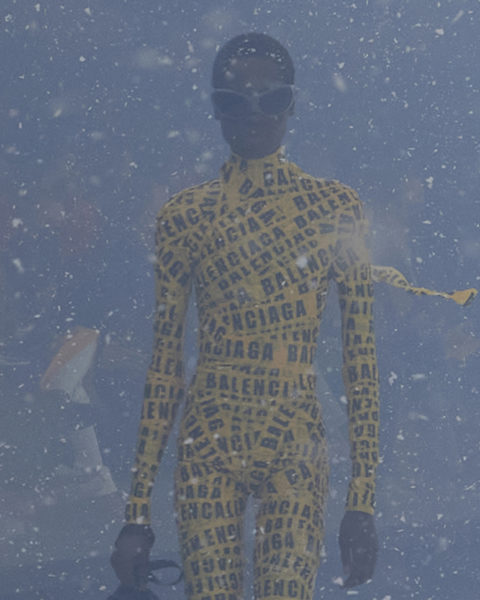
As fallout grows, the prevailing response is more of a question: Could this really be an accident? After all, Balenciaga thrives off of carefully crafted chaos. The brand hosts fashion shows in unconventional environments like simulated snow storms, mud pits and the New York Stock Exchange. It has collaborated with entities like The Simpsons and Fortnite, while enlisting unexpected celebs for catwalk cameos. It regularly releases absurd designs, from “destroyed” sneakers to trash bag totes. In recent years, Balenciaga’s meme-worthy style has become so unpredictable that theories suggest the fashion house is, in and of itself, a social experiment. Through it all, Demna has been known to weave deeper meaning and critical commentary into each of his astonishing antics. All things considered, some feel it’s hard to believe a misstep like this is just an oversight.

TikTok fashion commentator Jasmine Darya (@jasminedarya) argues the Balenciaga holiday campaign is not an ignorant mistake, but a result of the brand’s quest for clickbait. “I feel like in the last few couple of years, they’ve really gone towards this ‘anything to get a headline’ mentality,” she said in a recent video. “When you start relying on headlines and cheap publicity to sell your clothes as a fashion brand, that’s when you’re too far gone,” she wrote in the caption. But even with this problematic promotional look, is Balenciaga actually cancellable? Is any brand?

The thing is, in the world of fashion, social media outrage is reliably short-lived. Take Dolce & Gabbana. Despite having a track record of blatant misogyny, racism and homophobia, the Italian label has remained relatively unscathed, with seemingly unconditional support by A-list celebrities like the Kar-Jenners. And as chance would have it, Balenciaga, too, has star power on its side.

After reliably repping it over the past year, Kim Kardashian has basically become synonymous with the label. Despite calls for her to condemn this campaign, at the time of publishing, the beauty and shapewear mogul has stayed notably silent on the scandal, which is a statement in and of itself. We may never know whether the campaign was an intentional scheme or a tone-deaf blunder. But does the answer really matter? Despite how murky the ethics may be, it seems shock factor never goes out of style.

Thursday, December 8, 2022

Éric Pfrunder, Karl Lagerfeld’s Photography Wingman, Dies At 74

Éric Pfrunder, Karl Lagerfeld’s closest creative associate for his varied photography projects, died Monday in a Paris hospital at age 74 after a long illness, his son Jasper confirmed to WWD.

Services are scheduled for Friday at 3:30 p.m. at the Church of Saint-Germain-des-Prés.

Pfrunder was Chanel’s director of image for three decades, and remained as artistic director of fashion image for a brief period following Lagerfeld’s death in February 2019.

“A man of conviction and loyalty, a passionate worker, ‘vorarbeiter’ as Karl Lagerfeld affectionately called him, Eric tirelessly devoted his exceptional eye and vision to the excellence of Chanel, generously sharing his knowledge and insights with the image team and more broadly, the fashion division,” Bruno Pavlovsky, president of Chanel fashion, said in a statement shared with WWD, using the German word for foreman. “His contribution to Chanel is immense. We offer our most sincere condolences to his family and friends.”

Lagerfeld frequently said he had three key accomplices at the Chanel fashion house: Pfrunder, Pavlovsky and Virginie Viard, his longtime studio director, who would succeed the designer as creative director.

Indeed, it was Pfrunder who first suggested that Lagerfeld try his hand at photography.

Back in 1987, Lagerfeld expressed frustration with the images done for press kits at Chanel and so Pfrunder, flummoxed, suggested that Lagerfeld do them himself. It wasn’t long before Lagerfeld was shooting fashion spreads for French Vogue, and later campaigns for all the brands he touched, including Chanel, Fendi and the Karl Lagerfeld house.

Silvia Venturini Fendi, now Fendi’s artistic director for accessories and menswear, said the Roman house worked with Pfrunder for more than 30 years on all the Fendi women’s campaigns.

“He was the perfect creative match with Karl Lagerfeld bringing great value to our collaborations,” she said. “He was brilliant, eclectic, visionary and restless.

“His talent and great personality will be never forgotten.”

Pier Paolo Righi, chief executive officer of Karl Lagerfled, said Pfrunder was “Karl’s eye for photography and there were no limits for him when it came to Karl. Eric was a precious member of the Karl Lagerfeld family, he will be sorely missed and will always be remembered as a crucial part of Karl’s history.”

Sébastien Jondeau, a Karl Lagerfeld brand ambassador and product consultant, said with “anything involving image, Eric was there. He and Karl were very close, he was not only a work colleague, even if he was a workaholic for Karl.”

Jondeau and Pfrunder often vacationed with Lagerfeld, who treated all members of his entourage like family members.

Pfrunder worked at Chanel’s fashion division from 1983 until 2019 on image creation. On Tuesday, Pavlovsky described him as “an essential and active part of the creative trio” he formed with Lagerfeld and Viard, thereby “establishing Chanel as the ultimate luxury fashion house.”


Indeed, Pfrunder was forever at Lagerfeld’s elbow as the indefatigable German designer produced numerous books, catalogues and advertising campaigns, in addition to couture and ready-to-wear collections.

Outside advertising clients included Dior Homme, Dom Pérignon, Adidas, Coca-Cola and Pirelli, while the duo produced editorial shoots for scores of fashion magazines, including English and American Vogues, Harper’s Bazaar, Paris Match, V Magazine and Numéro.

The studio welcomed a host of models, Hollywood stars and European royalty, and Lagerfeld and Pfrunder would often set up impromptu photo studios at Chanel’s roving fashion events.

Inès de la Fressange, the face of Chanel in the ’80s, recalled how Lagerfeld ended up behind the camera. “We used to take Polaroids of each look for the fashion show,” she recalled, and the ones the designer snapped of her were strong. “I said, ‘Next time you should do the press kit.’ Karl said, ‘Oh I would love to but I don’t know the techniques.’”

Enter Pfrunder, who, knowing Lagerfeld’s deep admiration for German photographer Helmut Newton, wound up engaging one of Newton’s assistants to help the designer hone his craft, perfectly setting up the conditions for Lagerfeld to succeed.

“Suddenly, it was a new hobby for Karl and Eric was very happy,” de la Fressange recalled in an interview. “And with all these photo sessions, Karl had organized a new family.”

She said Lagerfeld had a lot of respect for the tailors, seamstresses and embroiderers that turned his sketches into sumptuous garments — and equally for all the contributors to a high-quality image.

Ultimately, Pfrunder would also help Lagerfeld organize exhibitions of his photography, and discover new ways of printing images, which excited the designer immensely, de la Fressange added.

“I spent a huge amount of my fashion career with Eric, who was in charge of everything to do with Karl Lagerfeld when he wore his photographer’s hat,” said Claudia Schiffer. “Eric was Karl’s ‘Monsieur Image,’ aka Chanel fashion director of image. I worked with the dynamic duo around the world – from New York City to Hamburg, Berlin, Nice, Buenos Aires and many more, which was so exciting. And of course, in Karl’s photo studio in Paris which is where our projects always started. Eric was the one who first encouraged Karl to pick up a camera and he was also a wonderful curator.

“Eric was both a family man and a gentleman with the finest manners, and a professional through and through,” she added. “He was so very knowledgeable and one would find him working away quietly in the background. I often think of him and Karl was very lucky to have found him. Eric admired Karl and was the most loyal, calm, and stable influence in the midst of fashion craziness. He gave up a part of himself to support Karl and I always felt in awe of him. There are not nor likely to be, many people like him in fashion. He was one of a kind and will be greatly missed.”

Born in Constantine, Algeria, Pfrunder moved to France at age 13. Like Lagerfeld, he was a self-taught photographer and also ran a communications and advertising agency whose clients included Norma Kamali, Emanuel Ungaro and Blackglama.

A tall, elegant man who shared Lagerfeld’s penchant for sharply tailored jackets, heeled boots and high-collared shirts, which he wore unbuttoned, Pfrunder largely flew under the media radar, and was in his element at the designer’s photo studio behind the 7L bookstore on the Rue de Lille.

Jondeau said Lagerfeld designed a special white shirt for Pfrunde, and had his go-to Paris maker Hilditch & Key deliver him a steady supply.

Among his projects after leaving Chanel, delayed by illness, were to digitize Lagerfeld’s vast photo archive, and publish a book, his son Jasper said.

Saturday, December 3, 2022

Dior And Denim Tears’s Tremaine Emory To Reveal Capsule Collection In Cairo

Dior Men’s artistic director Kim Jones is teaming up with Denim Tears’s founder and creative director of Supreme, Tremaine Emory, in the latest crossover between streetwear and luxury.

Dior will reveal a new capsule collection guest-designed by Denim Tears during an event at the Grand Egyptian Museum in Cairo on 2 December. “This line celebrates the inventiveness of the house of Dior and the strength of its creative dialogues,” Dior said in a laconic statement.

Jones’s previous guest designer was Californian designer Eli Russell Linnetz of Californian-based brand ERL. They presented their capsule as part of the resort show against the backdrop of the Los Angeles beachfront. Jones, a master of collaborations, has previously also joined forces with the likes of Sacai, Kaws and Daniel Arsham. In 2017, as Louis Vuitton’s men’s artistic director, Jones also oversaw the brand’s iconic collaboration with Supreme.


The new tie-up with Emory demonstrates the hold streetwear still has on luxury, five years on from when Supreme’s logo plastered Louis Vuitton bags. Emory, who has worked with Virgil Abloh and Kanye West, now known as Ye, founded Denim Tears in 2019 and joined Supreme in February. His brand is no stranger to collaborations: Denim Tears worked with Levi’s in 2020 on pieces adorned with a cotton wreath print, in a nod to his African American background; and Ugg in 2022.

The event will take place on the eve of Dior’s pre-fall 2023 menswear show at the Pyramids of Giza at Al Haram. According to HSBC estimates, sales of Christian Dior Couture surged to €8.8 billion in 2022.

Friday, December 2, 2022

Pantone Unveils Magenta As 2023 Colour Of The Year

Viva magenta, a red tone, will encourage optimism and allude to the rise of the virtual world as well as technology such as artificial intelligence in the months to come, Pantone said in a statement.

“We are creating a dynamic world that encourages experimentation, one that leverages the virtual within the physical realm and emboldens our strength and spirit to explore groundbreaking possibilities,” said Laurie Pressman, vice president of the Pantone Color Institute.


The release of the colour is accompanied by an immersive experience called the “Magentaverse,” a collaboration between Pantone and ARTECHOUSE, an art exhibit space. It will be on display in Miami starting December 3 as part of Art Basel Miami Beach.

Just a handful of luxury stalwarts are so synonymous with a colour that consumers can instantly equate the shade with the name. So, how does a brand own a tone, and should smaller labels try?

Haider Ackermann Plans To Explore Jean Paul Gaultier’s Quieter Side

Jean Paul Gaultier’s first haute couture show happened some 25 years ago, but Haider Ackermann still remembers its sublime chic and showed the goosebumps on his forearms as he described a sleek black suit with colorful feathers erupting from the sleeves.

As the latest guest couturier at Jean Paul Gaultier, slated to show a one-off collection in January during Paris Couture Week, Ackermann cited a wish to exalt the legendary designer’s quieter side, including his tailoring prowess.

“I wanted to explore this purity, which is absolutely magnificent,” he enthused. “Sometimes all those millimeters are forgotten, how perfect couture can be.”

In an exclusive interview with WWD, the two designers described their long admiration for each other’s work and their mutual belief in original creativity and technical excellence.

For his part, Gaultier remembers reading in Le Figaro about a hot new Belgian designer named Haider and being dazzled by his sophisticated colors and unexpected silhouettes.

“It was different and at the same time classic, but with a twist,” he said.

He described in detail a bomber jacket with an extra-long zipper that undulated down the front of the garment like a ruffle and confessed thinking: “Ah, it’s a pity I didn’t have that idea myself.”

Seated opposite each other on black sofas in Jean Paul Gaultier’s couture salon designed by Philippe Starck, the two men shared a laugh after that quip, demonstrating an appreciation for design peers that inspired them to further sharpen their creativity.

Ackermann put in a plug for Marina Yee, one of the lesser-known of the Antwerp Six that put the small Belgian city on the international fashion radar in the ’80s and ’90s. “No one talks about her, but she was highly, highly talented,” he said.

For his part, Gaultier argued that Martin Margiela should have been included to make an Antwerp Seven, even though Margiela graduated a year earlier than the famous graduates of the Belgian city’s Royal College of Fine Art. “When I went there, I discovered how good they were: They were knowing everything, so professional. It’s a very good school, I should say better than the French one,” he said.

Gaultier famously hired Margiela as his design assistant in 1984 and three years later the Belgian wunderkind would branch out on his own. Gaultier lauded the unique spirit around fashion emanating from the north and how its designers interpreted tradition in new ways.

Ackermann confessed that Gaultier was on his radar from his days as a fashion student in Antwerp, when he would come to Paris and sneak into fashion shows.

He recalled the fall-winter 1994 collection dubbed “Le Grand Voyage.” Gaultier staged the show in some frigid warehouse in the 15th arrondissement and had Björk modeling looks inspired by Inuit costumes.

Ackermann recalled being “transported to other worlds” at Gaultier shows. “He made you travel with your mind,” he said. “You just had to take the Metro a few stops and you would completely enter a different world, and that was very mind-blowing for us.

“Your imagination was just exploding, which was really, really beautiful,” he said.

Gaultier interjected with a few unknown tidbits about that 1994 show. For one, he didn’t have official authorization to use the venue.

Second, “everybody was crying but not because of the beauty of the show but because I had put fake snow on the ground and it was very irritating to the eyes,” the designer said with a long and hearty laugh.

After retiring from the runway in early 2020, Gaultier had the idea to invite a guest designer each season to realize a couture collection, drawing on his 50 years of fashion creation. He came up with the concept way back after the house of Jean Patou, where he worked early in his career, found itself without a designer.

Ackermann referred to himself several times as “No. 4,” following one-off Jean Paul Gaultier couture collections by Chitose Abe of Sacai, Glenn Martens of Y/Project and Olivier Rousteing, creative director of Balmain.

Gaultier underscored that his intention was to invite accomplished and established designers with strong signatures to interpret his oeuvre, bringing ideas that would never had occurred to him.

For example, he motioned to a corner of the vast couture salon, where a Stockman was dressed in a striped top sculpted from glass — a direct reference to Gaultier’s hit 1995 fragrance Le Male. It was the opening look in Rousteing’s one-off couture effort last July.

Likewise, Gaultier marveled at the way Martens elaborated on his corset dressing in a way that he would never have considered.

“I think it’s important that they bring their personality. So what is interesting is inviting someone who has character, and who has a style that can add to my style,” he explained. “He or she has to bring something else.”

Both men said good fashion from their peers encourages them to give the best of themselves.

“When Comme des Garçons first came to Paris, I loved it, but I didn’t wish to make anything like that. But in reality, when you discover a very good collection, it gives you energy for yourself to do something nice,” Gaultier said. “I don’t take their idea, but I will try another one. You must not be influenced by the other, because it’s your personality. Of course, it depends if you want to create or you want to follow.”

Ackermann said he also finds motivation from certain designers, headlined by Gaultier: “When you look up to people, it makes you want to move forward as well, and that’s great.”

While he never attended a Haider Ackermann show in person, Gaultier said he was always struck by the sophisticated colors, often acid-tinged, shown in interesting combinations. Gaultier also lauded Ackermann’s shapes, minimal and focused “without a lot of effects… which I think is great and I respect because sometimes I add a little too much — the contrary of minimal.” He laughed again.

For his part, Ackermann said Gaultier “opened his mind” also because he “pushed the envelop in culture and society,” referring to the designer’s very early celebrations of sexual and racial diversity and his embrace of high and low cultures.

“Every conversation we are having nowadays in 2022, he had them back in 1994 or even earlier,” Ackermann marveled.

“I came from a very Catholic surrounding, very protected,” said the Colombian-born designer, who was raised in Africa and the Netherlands. “Suddenly there was somebody else talking about other subjects… about the gay community, about the Black community… He opened up a wider world for me.”


Now he’s opened up haute couture to a rotating cast of newbies, a gesture that Ackermann lauded as generous, courageous and open-minded.

“It’s a difficult exercise, but it’s a beautiful exercise,” he said. “When the house approached me, strangely I immediately knew what I wanted to do. It was an instinct.”

His mind went immediately to Gaultier’s couture debut, rich in immaculate tailoring, and he wished to honor him by exalting that legacy.

“We all know the madness, the craziness,” Ackermann said, alluding to the designer’s theatrical and outlandish side. “I mean, the Jean Paul Gaultier dictionary is so big, there’s so much to be taken in, so much to absorb.”

While the designer knows that dictionary well, he still took a dive into the Gaultier archive.

“It’s a luxury, seriously, you should it do one day,” he enthused. “Also because you recognize how much he has been doing, it’s remarkable. I mean, it’s embarrassing to talk in front of him about this. But the things we are doing nowadays were already there back in the ’90s. I think any fashion student should come look at the archives. Because the references go a long way back, even though we’re thinking they’re from yesterday.”

Gaultier and Ackermann had dinner together once the contract was signed but the conversation kept clear of the project at hand.

Gaultier stressed that each guest designer gets carte blanche, and he does not wish to influence him or her in any way — and discover the couture collection along with the rest of the audience during the couture-week show.

“It’s because of respect and also confidence in the person,” he said.

Gaultier said when he’s collaborated with filmmakers, for example, it is risky to accept too many recommendations because then you end up wishing to please the person instead of “doing the spontaneous things that I should do.”

Echoing other guest designers, Ackermann said it’s been a longtime dream of his to touch haute couture.

“Since a child I was dreaming of couture. Christian Lacroix was also one of the people I admired,” he said. “When you work with the atelier, you really feel the love and the passion they have for this job. It’s not like a regular job. There’s intimacy and love in the details, in the time devoted to it…. And everyone has so much admiration for Monsieur Gaultier. It’s really sweet to listen to them. It’s very tender.”

Gaultier interjected, motioning to Ackermann and chuckling: “And from what I heard, they have a lot of respect for him.”

Yet he is relishing the surprise of the big reveal next January. “It’s a little pleasure I give myself,” he said, recalling the thrill of attending a few shows by other designers, including Thierry Mugler, early in his career. “I was loving to discover what he did, and be surprised,” he recalled. “I loved how strongly he was into his own style — to have the audacity to be outrageous sometimes.

“When you see people that have talent, it’s always very good and very positive, bringing good energy and we need that, you know. It makes you dream.”

Ackermann said he’s relished the project so far, stressing that haute couture is “much more focused and concentrated” than ready-to-wear. “The exercise is more beautiful, you go much more in the details. And also because you take the time, which is a true luxury nowadays, to make a collection…. I’m really blessed and happy to be here, seriously.”

Ackermann demurred when prompted to give some hints about the collection.

“He and I are very different people. He’s very open, generous, very joyful. I’m much more discreet and shy,” he said of Gaultier.

Yet after his trawl though the Gaultier archive, Ackermann found “that we both talk about different cultures; we both talk about masculine and feminine; we both have an admiration for tailoring. I think we are both in love with women. So I think all those subjects that he and I share are things that I’m going to try to put out there and show what we have in common.

“Also, I’m going to try to find this fine line of playfulness,” he continued. “I will explain afterwards when the collection is done how every reference came from Monsieur Gaultier, but then I translate it in my own way, how I would say it in 2022.”

Ackermann, whose last runway show for his signature ready-to-wear collection was for fall-winter 2020, has been largely flying under the radar, making a big splash here and there by dressing the likes of Tilda Swinton and Timothée Chalamet for key red-carpet appearances.

According to market sources, the designer recently settled a trademark tussle with his previous backer, which will free him to relaunch his eponymous label in future. He was mum on the timing for that project.

In the meantime, he has been absorbed in the haute couture project, and a co-ed collection for Italian sportswear brand Fila that he unveiled at a runway show in Manchester, England, last month.

Asked if he had a favorite collaboration during his long fashion career, Gaultier spoke about some that got away: In the early ’90s, he was approached regarding collaborations with Nike, Adidas and others, which he would have loved to do but could not because of contractual reasons.

“Sorry to interrupt, but how avant-garde is this man?” Ackermann interjected, agog at this revelation.

“I have been influenced by sportswear, of course,” Gaultier added. “It’s why I did Junior Gaultier at that time.”

Asked if there’s any collaboration he would dream to do now as a personal project, Gaultier said he’s “more into musicals and things like that.”

To wit: He has been conscripted by the Friedrichstadt-Palast theater in Berlin to help mount another show. “I like doing those kind of things, which are around fashion, but not real fashion that you have to wear.”

Thursday, December 1, 2022

Ludovic De Saint Sernin Has Been Named Creative Director At Ann Demeulemeester

It’s been a busy couple of weeks for fashion. Following Alessandro Michele’s departure from Gucci, the shuttering of Raf Simons’s eponymous label and Estée Lauder’s agreement to buy Tom Ford, there’s news today from the Claudio Antonioli-owned Ann Demeulemeester brand that Ludovic de Saint Sernin has been named its creative director.

De Saint Sernin’s appointment signals a creative change for the company. Antonioli, who co-founded the New Guards Group, bought Ann Demeuelemeester in 2020 and until now has run it with an unnamed design team. Though she stepped away from her namesake label nearly a decade ago, Demeulemeester herself is tangentially involved. It’s an an unusual arrangement, but she and Antonioli are friends, and so she oversaw an exhibition of her archive at Pitti Uomo this summer and has given her blessing, it would seem, to collections made very much in her image.

Like Demeulemeester, De Saint Sernin was born in Belgium. The Paris-raised, l’ESAA Duperré-educated designer launched his eponymous label in 2017 and quickly garnered notice for the hedonism of his aesthetic and a binary-breaking approach to clothing design. De Saint Sernin is a proponent of what could be called equal opportunity nudity, putting all genders in sheer suits, crystal mesh tanks, lace-up briefs and “body-formatted” knits, and he has built a starry fanbase of It-girls and It-boys for them – Dua Lipa, Hailey Bieber, Bad Bunny and Troye Sivan among them.

His collection’s sex positive glamour is attention getting, but it also comes from the heart. He’s just as likely to be wearing his stretch tank top as Ms. Bieber is. “The way that I design for the brand is like a journal, it really is autobiographical,” he told Vogue recently.


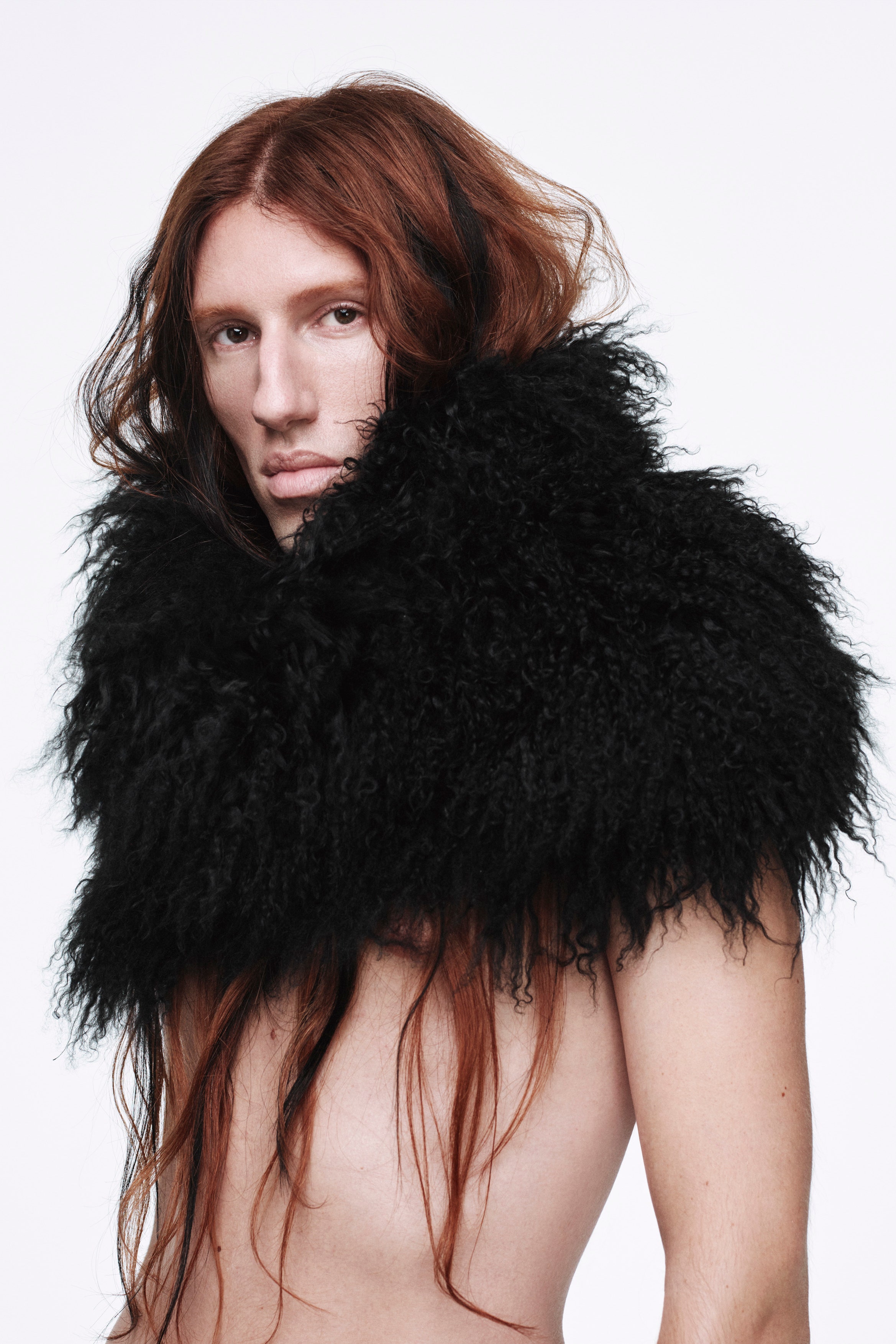
The pictures the company has released suggest he’ll be taking a similar approach to his new gig. The Willy Vanderperre-lensed shots are portraits of De Saint Sernin in archival Ann Demeulemeester. In one he wears a black shearling collar, for the others he chose a single-breasted suit, a see-through knit, a one-shoulder sheath and a bias-cut silk maxi skirt. The press statement reads “authorship and autobiography gain centrality, as Ludovic de Saint Sernin shapes the Ann Demeulemeester traits around his vision, proclivities and individuality, offering a first-person reading and the connection with today’s audience that comes from that.”

In her time, Demeulemeester built her own cult of personality, making devotees who went back to her Couvent des Cordeliers location season after season for poetic shows full of fluidly constructed tailoring, slouched-on shirting, bias cut dresses and her signature butch-femme mix of leathers and feathers. Her celebrity muses included Robert Mapplethorpe and Patti Smith.

In an interview with Vogue Runway’s Laird Borrelli-Persson on the eve of her Pitti exhibition, Demeulemeester said, “I was interested in the tension between masculine and feminine, but also the tension between masculine and feminine within one person, that is what makes every person really interesting to me because everybody is unique.” She and De Saint Sernin have that sentiment in common.

Jimmy Choo, Timberland Collaborate With Harlem’s Fashion Row

Luxury accessories brand Jimmy Choo has collaborated with Timberland on a second capsule collection inspired by the Big Apple.

The two brands have enlisted the help of Harlem’s Fashion Row, an agency that bridges the gap between brands and designers of color in fashion.

The agency has introduced Jimmy Choo and Timberland to New York-based designer Shanel Campbell, whose work focuses on the Black experience in America.

“Collaborating with two brands was one of the most interesting things I’ve ever done. I was constantly asking myself, what does it look like when these worlds, Jimmy Choo and Timberland, collide? It was an amazing experience collaborating with another woman in a creative director role,” said Campbell.


She said she was inspired by Jimmy Choo’s creative director Sandra Choi’s position within the fashion and luxury space.

The capsule collection includes seven styles for men and women available now. The most distinct styles are the two hot pink velvet boots; the classic nubuck boots with a graffiti script that reads “Jimmy Choo”; a black boot with Swarovski crystal embellishment, and a thigh-high black leather harness boot with dual styling functions, transforming into a 6-inch boot.

“Working with Harlem’s Fashion Row and Shanel Campbell brought a new dimension to the collaboration. Shanel infused the collection with her authentic New York creative lens, a true New Yorker living and breathing the heartbeat of this vibrant city. I love to mix it up by getting together with interesting creative minds, combining our DNA to create beautiful and surprising pieces,” said Choi, describing the collaboration as a celebration of urban glamour, resilience and the eclecticism of the city’s dynamic community.

The campaign shot on a New York rooftop features musician and actress Justine Syke and rapper and producer Pi’erre Bourne. It is accompanied by an interview with Campbell.