Monday, April 25, 2022

Isabelle Huppert’s Top Tips For The Biennale As Louis Vuitton Kicks Off The Venice Art Fair

On the opening night of the Biennale in Venice, Louis Vuitton hosted a dinner to celebrate the reopening of the late-Gothic Palazzo Ca’ d’Oro. The fashion house has contributed to the museum’s restoration in collaboration with the Venetian Heritage Foundation and the architect Peter Marino, who couldn’t help but shed a tear of joy during his welcome speech. Looking as dazzling as her palatial surroundings in a courtly leather look from Nicolas Ghesquière’s spring/summer 2022 collection was Isabelle Huppert, whose ties to Louis Vuitton are as strong as her history with Venice. “It goes back since I was 15 years old. My sister and I took the train at Christmastime. It was so powerful,” she said of her first experience of the city. “I did a movie in Venice: The Wings of the Dove – Henry James – and of course my main relationship is with the movie festival. I got Best Actress twice,” she says, smiling cheekily.

Huppert knows her art and had already spent the day touring the pavilions of Giardini delle Biennale and the coinciding exhibitions around Venice. “The installation by Katharina Grosse is really beautiful,” she said, referring to the German artist’s Apollo, Apollo show in the Espace Louis Vuitton Venezia. “It’s the idea of light in Venice. It covers a whole wall, and there’s light behind the fabric so when you walk along the light shifts. It’s beautiful.” Another of Huppert’s highlights was Anselm Kiefer’s Questi scritti, quando verranno bruciati, daranno finalmente un po’ di luce (“These writings, when burned, will finally cast a little light”) at the Doge Palace. “Oh my god, did you go there? It’s just amazing! But it has to be amazing because it’s covering the Tintoretto paintings,” she said of the original works that grace the walls of the palace’s main hall. “It has to be at that level, and it is.”


“It’s very, very impressive,” Huppert said. “I’ve known Anselm’s works for years but this is really striking, because the space is striking so you have to fill it out. It’s about vitality and eternity and death.” The Biennale isn’t only an opportunity to showcase the works of contemporary artists from around the world, but a vehicle for brands like Louis Vuitton to pledge their support to Venetian culture and heritage through contributions to the restoration of buildings like Ca’ d’Oro, and invaluable historic artworks. Alongside the MUVE Foundation, which manages the protection of Venetian heritage, the fashion house is currently restoring a series of paintings by the French Post-Impressionist painter Émile Bernard, which will be shown at the Espace Louis Vuitton Venezia later this year before returning to their home in the Museo Correr in St Mark’s Square.

As part of the opening of the Biennale, the Golden Lion awards for best exhibitions were presented this weekend. The British artist Sonia Boyce won Best National Participation for her work “Feeling Her Way”, while the American artist Simone Leigh won Best International Exhibition. “The American pavilion was very powerful,” Huppert said of Leigh’s work. “And the French pavilion [by the Franco-Algerian artist Zineb Sedira] was very interesting. It’s about a love of cinema: quotes about films from Ettore Scola to Visconti.” But it was the Belgian pavilion that got Huppert’s douze points. “It was really wonderful. It’s all about children from different countries and communities: a series of videos of children playing. It’s a promise for life; all these kids in Africa, Afghanistan and Mexico,” the actress said, concluding her highlights from her first day at the Biennale.

Friday, April 22, 2022

The Metaverse And The Future Of Chinese Influencer Marketing

This year’s hottest concept is still the metaverse. According to data compiled by Qichacha, 1,692 Chinese companies applied for over 11,4000 metaverse trademarks by the end of 2021. But what exactly is the metaverse, and how can it transform a China marketing strategy? 

What is the metaverse?

In simple terms, the metaverse is a realistic virtual world.

In this brave new digital world, people can generate interactions, and take part in virtual concerts or luxury shopping experiences. It serves as a social reality, digital economy and anything else you want it to be.

It’s estimated that by 2025, more than 3% of Chinese consumers will have a virtual identity in the metaverse.

Who’s using the metaverse in China?

Today, the main metaverse users are Chinese gen Z.

This generation are true digital natives, having grown up alongside social media and internet-enabled devices. They’re highly accustomed to virtual concepts mirroring the real world, and demand immersive, interactive and unrestricted experiences in the digital sphere.

Chinese gen Z is hyper-aware of the consumption experience, with little patience for complicated or outdated websites and processes. Equally, they’re more than willing to pay for fun, personalized and unique online experiences.

So, could the metaverse be the future of China digital marketing to the younger generation?

The metaverse market explosion

From September to November 2021 alone, there were 26 individual China metaverse-related companies with investments of over RMB 10m. In addition, 35 foreign companies were working in the China market, with total investments exceeding RMB 10bn.

The market grew to $540m in 2020 and reached around $970m by the end of 2021. Expansion is further set to skyrocket in the coming years.

One Chinese MCN company published an open letter simply mentioning the metaverse, which led to its market value soaring by over 5bn yuan. Similarly, the software chip giant Nvidia’s share price rose by over 12% due to its metaverse infrastructure project Omniverse.

With a high prevalence of Chinese gen Z users, the metaverse is also perfectly suited to new technological developments such as non-fungible token (NFT) art collections or China’s burgeoning ‘blind box’ economy.


Introducing virtual influencers

Western brands have successfully partnered with Chinese social media influencers such as Key Opinion Leaders and Consumers (KOLs and KOCs) for many years. It’s a fantastic way to enter a new market, creating trust, brand awareness and authenticity.

Despite this, it’s not an entirely risk-free approach. Many China social media stars (such as Kris Wu, Zhang Zhehan, Zhao Wei and Lucas Huang) have recently become embroiled in scandals, with negative implications for brand partnerships.

So, what’s the solution? Enter virtual influencers...

What is a virtual influencer?


A virtual influencer is a digital internet celebrity, with their own personality and interests. They can take part in livestreaming, brand endorsements and just about any China marketing activity you can think of.

Unlike real influencers, virtual idols don’t need constant management or tricky arrangements with conflicting schedules. They can adapt to brand strategy and don’t get caught up in ‘real-world’ controversy.

Of the 80% of Chinese netizens following online celebrities, over 60% follow virtual idols – with over half spending at least 500 RMB a month on related purchases.

Virtual influencers have struck a chord with young Chinese consumers, with interaction rates often three times higher than their real counterparts.

Case study: Ayayi x Burberry

Luxury fashion houses are quickly capitalizing on this new trend, with Burberry’s recent collaboration with Ayayi being just one example.

Launched in May 2021, Ayayi is a hyper-realistic digitized person. On her debut, she gained 400,000 followers overnight and nearly 3m views on her first post. Working with Ayayi, Burberry launched a limited-edition NFT linked to a physical collection.

As part of this pioneering China digital campaign, Burberry unveiled a 3D animation of its deer mascot wearing a Burberry scarf. The scarf was also available in physical form, retailing at 2,900 RMB. Inspired by Ayayi’s digital friendship with the Burberry deer, the special collection completely sold out.
Creating meaningful connections with metaverse marketing

As virtual idols become an increasingly important part of content marketing in China, it’s vital brands get these collaborations right.

Just like real influencers, it’s crucial to assess whether a virtual influencer fits a brand’s identity, goals and objectives – as well as create content and unique events (whether it’s fashion shows, social gatherings or competition giveaways) that genuinely resonate with followers.

As is the ‘real world,’ it’s always better to work with influencers suited to a brand niche, rather than superstar idols who don’t authentically relate to consumers.

How To Create A Successful Luxury Brand: The Ultimate Guide

What is it about high-end brands like Louis Vuitton, Cartier and Hermès that make us wait for years on end for a new handbag, watch or masterpiece? Why is Rolex more desirable than Swatch, or Armani than Abercrombie?

If you want to create a successful luxury brand like Chanel or Dior, first you need to know what it is about luxury that is so evocative in the first place.

Defining a Luxury Brand

Let’s start with what a luxury brand is. Luxury brands are those that, in their customer’s mind, are associated with a high level of quality, aesthetics, exclusivity and price.

Premium brands don’t cater to needs nor do they offer solutions to problems. They create dreams and offer nonessential goods that are made desirable.

What Makes Luxury Brands Different

Creating a strong luxury brand identity is not only about a fancy logo, an intriguing color palette or an impeccable design. It’s about creating and communicating its symbolic value to a specific segment of customers.

Luxury brands and traditional brands operate on two very different levels. What makes premium brands different is that they connect with their audience on an emotional level, to elicit purchases that escape rational decision-making. Luxury brands don’t seek to be liked by everybody. Instead, they aim to educate in taste, which is why they surprise their customers with products they were not expecting.

The 6 most essential steps for creating a strong, successful luxury brand:


1. CELEBRATION OF TRUE CRAFTSMANSHIP

Whether it’s Bentley hand stitching the interior fabrics of their cars or Gucci’s impeccable crafting knowledge passed down through generations, one key element of luxury brands is that craftsmanship is essential to their story.

Today, true luxury is the combination of the finest quality materials and the highest standards of handcrafting. Luxury brands focus on a higher level of artistry and durability that sets them apart from mainstream brands, following a process that resists automation.

Celebrating the process as well as the product is an important reason why customers accept paying more for luxury goods.

Gucci École de l’Amour represents an innovative way to pass on know-how and develop skills associated with the House’s artisanal craft and production methods

2. A RICH HERITAGE

Heritage taps into powerful emotions such as stability and a sense of belonging. Luxury brands use their heritage story to leverage their perception of exclusivity and finest quality.

There are different ways to tap into heritage: Some high-end brands create a sense of nostalgia for the “good old days” to emphasize on the idea of craftsmanship and artistry. Others, through the stories of their remarkable founders (like Coco Chanel or Salvatore Ferragamo) or revolve around the roots of their national sense of self (like Bulgari, which references Ancient Rome in their logo typeface).

3. OFFER A FLAWLESS BRAND EXPERIENCE

Luxury isn’t just about the product, it’s about the whole experience. Your brand should demonstrate refinement at each point of contact with your customer, from product packaging to the knowledge of your retail sales staff.

Because premium brands rely on a stronger connection with their customers, they need to create and offer a memorable brand experience as part of their brand. VIP events, access to limited editions or invitation-only pre-launches… make sure you design for exclusive experiences that elicit respect, attention and appeal.

4. THE PERFECT COMBINATION OF EXCLUSIVITY AND RARITY

A perception of exclusivity is one of the most important elements that helps a brand possess symbolic value.

High-end brands know this very well; which is why they ration their goods and produce limited editions that customers are willing to wait years for. Strive to create exclusivity through premium quality, high prices, low supply and geographical limitations.

Scarcity and exclusivity are some of the most powerful marketing tools available, and can be used wisely and strategically when creating a luxury brand.

5. A GOOD STORY THAT BECOMES A LEGEND

Luxury brands have stories to tell. Think of the Tiffany box, famous for generating excitement worldwide. These are the emotional connections that high-end brands seek to engage in with their customers, and they do so through storytelling by reflecting their dreams, aspirations and needs to be seen and recognised.

The heightened identity luxury brands are known for captures all of its elements: its promise, its unique personality, its premium products and its impeccable brand experience.

6. EDORSEMENT BY PUBLIC FIGURES

Public figures help high-end brands with their brand positioning, drawing attention, credibility and intrigue.

Sometimes it’s the very founders who play an important role in communicating their brands through their personalities, like Donatella Versace or Vivienne Westwood. Other luxury brands select specific public figures, ranging from film stars (Charlize Theron for Dior), to designers, athletes (Roger Federer for Rolex) and musicians (Harry Styles for Gucci) to represent their values and create mystique.

Stella McCartney Delves Into Disney’s ‘Fantasia’ For New Capsule

Stella McCartney is adding some magic to her mushroom-themed spring collection with a capsule of psychedelic clothing based on Walt Disney’s 1940 musical film “Fantasia.”

The unisex collection was inspired by McCartney’s love for the film, which was radical for its time, mixing experimental visual effects with classical music by composers including Bach, Beethoven and Tchaikovsky.

The clothing, accessories and kidswear reference the film’s colors, characters and, of course, Mickey Mouse, who appears in many guises. Scenes drawn from the film include “Rite of Spring” and “The Sorcerer’s Apprentice.”

McCartney told WWD that her mother, Linda, “was a huge fan of Disney, so I grew up watching ‘Fantasia.’ I loved escaping reality into this colorful and psychedelic world of magic, animals and powerful symphony music. It was ahead of the time then, and is more relevant than ever now. It felt natural to trip into ‘Stella McCartney Presents Disney Fantasia’ from our love affair with the magic of mushrooms.”

She said the capsule taps into the brand’s “ageless and youthfulness — and I’m so excited to introduce one of Disney’s most beautiful animations to a new generation through fashion.”

This is McCartney’s second collaboration with Disney following the International Women’s Day and Disneyland Paris project that saw her design a trouser suit for Minnie Mouse. It is also an extension of her spring 2022 campaign “Mushrooms Are the Future.”

For her spring 2022 collection, McCartney drew inspiration from the 2019 Netflix documentary “Fantastic Fungi,” staging her show at Espace Niemeyer in Paris, in a room that resembled the frilly underside of a champignon. The show featured synthesized music created from the sound of mushrooms living and growing.

During that show, McCartney debuted a bag made with mycelium leather courtesy of Bolt Threads, the California-based company with which she’s been working, and showed off vegan, recycled and regenerated cashmere, nylon and animal-free leather.


In the capsule, Mickey Mouse hand motifs and art from rare, 1940s posters appear across limited-edition, repurposed silks from the LVMH Moët Hennessy Louis Vuitton Nona Source, a start-up that emerged from the group’s incubator program that makes unused luxury fabrics available to the group’s brands. Knitwear sparkles with PVC-free sequins.

The sustainable Loop sneaker showcases rainbow Mickey Mouse graphics, while the brand’s signature Elyse platforms feature Fantasia prints.

Accessories include the Falabella bag covered with rainbows and dotted with crystals, and black recycled backpacks and camera bags with contrasting white Mickey Mouse motifs.

The capsule will be released on Thursday, April 8 on the brand’s site, with prices ranging from 50 pounds to 2,500 pounds.

Fantasia is the latest in a long line of McCartney capsule collections that riff on cultural moments from the designer’s past, and music made by her father Paul McCartney and The Beatles.

Her women’s pre-fall and men’s fall 2019 collections were inspired by the 4K-digitized, re-released version of “Yellow Submarine.” She worked illustrations from that film into an embroidered jacket and whipped Pop Art portraits into intarsias on regenerated cashmere knits.

Last November, she released a “Get Back” unisex collection inspired by the Disney+ documentary directed by Peter Jackson.

That collection featured graphics and typography inspired by the band’s album covers, and psychedelic prints done by their longtime collaborators, The Fool collective, whose artwork McCartney discovered 
hanging on a wall at her father’s house.

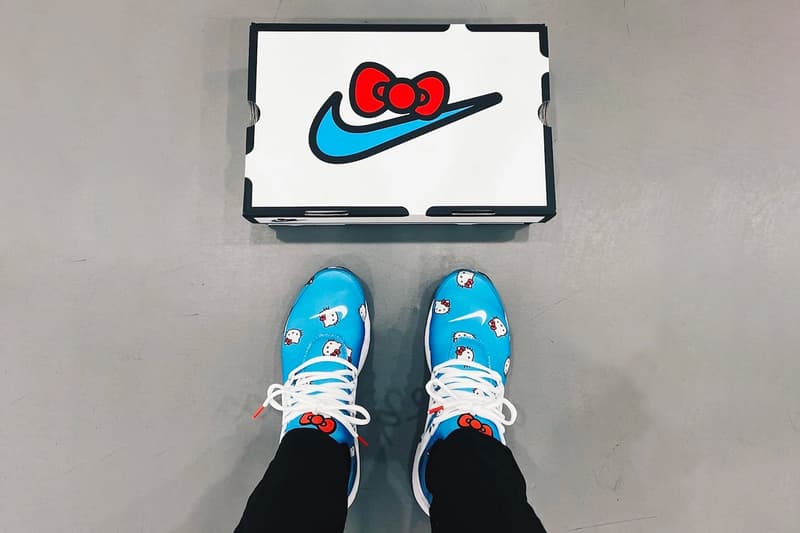
Take A First Look At The Hello Kitty x Nike Air Presto

To celebrate the 30th-anniversary of Hello Kitty, an ultra-limited batch of Hello Kitty x Nike (NYSE:NKE -0.30%) Air Prestos, estimated to be around 12 pairs, were released to friends and family in 2004. Following a series of rumors earlier this year ignited by leaked images of collaborative apparel, a modern revival of the Hello Kitty x Nike Air Presto has now been confirmed.

The upcoming pairs arrive in “University Blue” mesh uppers and a “White” TPU cage with Hello Kitty logos scattered across the silhouette. Red ribbon motifs are featured on the tongue, and white rounded laces are accented by red lace tips. Mudguards and heel tabs arrive in translucent materials, and a modified heel displays Hello Kitty’s signature facial features. 


Rounding out the design are cartoon graphic insoles, white midsoles with thematic lateral dots, and black rubber outsoles. The custom shoebox compliments the footwear release with sharpie Nike and Hello Kitty ribbon logos. Take a first look at the Hello Kitty x Nike Air Presto above, and expect the pairs to arrive on May 2 on Nike’s website and select retailers for $140 USD.

Thursday, April 21, 2022

Inside Alexander Wang’s L.A. Runway Return With ‘No Interviews’ And A Charitable Turn

“No interviews,” press was told at Alexander Wang’s runway show in L.A.’s Chinatown on Tuesday night. And no photography.

Journalists were also kept out of the wrap party — open to “friends and family” only — at General Lee’s. Seemingly everyone but media was being let inside the doors of the cocktail bar, however, which was among the businesses in Chinatown Central Plaza included as part of Wang’s “night market.” Shops were open after-hours, allowing wanderers to browse inside, while local food vendors — the Golden Dragon Restaurant, Pearl River Deli and Gigo’s Cafe & Deli, among others — offered bites of dim sum, roasted duck, barbecue skewers and treats like shaved ice and boba.

“Fortune City” was the name of the 51-look presentation, featuring pre-fall and fall 2022. To the beat of FKA Twigs’ “Honda,” the runway show opened with leather and denim looks against a fire-red backdrop, down to the carpet, showered in red floodlights. The set design, showcasing two majestic guardian lions, took inspiration from Chinese banquet halls (an ode to the designer’s Asian American heritage, he was born to Taiwanese parents).

Leather thigh-high boots were paired with micro-mini skirts and long, relaxed leather coats; oversized white button downs with boxy blazers; cropped tops and bodysuits with baggy knee-length shorts. It was an androgynous uniform of indigo, brown and black, in keeping with Wang’s street-sportswear sensibility.

Knitwear was presented as shapewear, with heavy wools made into bike shorts and shrugs. Wang has developed a new wool fabrication with stretch, noted the brand. Then came the mini bodycon dresses in ruffled smocked Lycra, juxtaposed with the hard leather boots (in black and metallic silver). A very pregnant Adriana Lima got the loudest cheers of the night when she strutted out in an all-black version made with a massive belly cut-out.

There were other big-name models walking the show — emerging from the neon storefront of KG Louie Co., the antique and gift shop opened in 1938 — including Candice Swanepoel, Alessandra Ambrosio and newcomer Amelia Gray Hamlin, the 20-year-old daughter of actors Lisa Rinna and Harry Hamlin, watching proudly from front row.

The VIPs stayed clear of doing interviews, too, likely shying away from having to answer any questions regarding Wang’s sexual misconduct allegations. It was the designer’s first show since June 2019.


The 800-name guest list included rapper Bia, who mingled and posed for cameras with Kimora Lee Simmons; music artists Gunna and CL; newer faces like YouTuber Nikita Dragun and TikToker Noah Beck, as well as “Euphoria” actress Chloe Cherry. There was also model Behati Prinsloo; DJ Peggy Gou; twin sisters Simi and Haze Khadra of Simihaze Beauty; and Rinna’s “Real Housewives” costar Erika Jayne (currently making headlines for her own legal troubles).

“I clocked it,” Jayne told Stephanie Shepherd. “I said, ‘That’s Stephanie, and there’s something on that left hand.'”

Shepherd, the former personal assistant to Kim Kardashian, held up the bling on her ring finger: “Always watching.”

For his return, Wang brought a charitable element to the event, donating an undisclosed amount to the Los Angeles Chinatown Corporation, which works to preserve the historic Chinese architecture of the city. All proceeds from sales of a limited-edition T-shirt series will also go toward the cause.

Back on the runway, Wang ended with his latest take on athleticwear: roomy velvet tracksuits in red and black. And for the finale, gowns in white jersey with Madame Grès-inspired draping.

He closed with the thumping sounds of Black Box’s “Everybody Everybody (Le Freak Mix)” as a rain of red confetti covered the crowd.

Monday, April 11, 2022

Ashton Kutcher Is Among Investors in Digital Fashion House The Fabricant

The Fabricant, a digital fashion house with an ambition to build the “wardrobe of the metaverse,” said it has secured $14 million in a Series A funding round.

Among new investors in the Amsterdam-based firm are Ashton Kutcher and Guy Oseary’s Sound Ventures, Red DAO and Koji Capital.

The Fabricant said the new funding, led by Greenfield One, would support and expand its “co-creation and NFT platform” dubbed The Fabricant Studio.

“The company’s ultimate mission is to build a decentralized fashion house that will dress the population of the metaverse and create a more equitable, creative and sustainable fashion industry,” the company said in a release. “The Fabricant Studio allows anyone to create, trade and wear digital-only garments.”

It estimates that by 2025, 100 million people will be metaverse-ready and clad in digital garments, and it touts The Fabricant platform as a place “where anyone can become a digital fashion creator and participate in the digital fashion economy.”

Established in 2018, The Fabricant creates digital couture NFT collectibles for the 3D digital fashion space. To date, it has worked with brands including Adidas, Off-White, Napapijri, Puma and Peak Performance.


The Series A round includes “renewed participation from previous investors including 4impact, Slingshot Ventures and Borski Fund.”

Other contributors to the A round include Stefano Rosso, son of Diesel and OTB founder Renzo Rosso, a member of the OTB board, and chief executive officer of Brave Virtual Xperience, a new company created to help brands across its portfolio develop projects, products and initiatives intended for the metaverse.

The Fabricant also noted that Epic Games recently awarded it a mega-grant open to digital creators for projects utilizing its Unreal Engine software.

“Within virtual environments, we are likely going to have multiple digital reflections of our physical self,” said Jascha Samadi, partner of Greenfield One, one of the new investors. “The Fabricant Studio allows any creator to become their own fashion designer in the metaverse. Paired with Web3 technology, digital fashion becomes unique, tradable and accessible for the masses.”

Samadi added that the team behind The Fabricant “identified this paradigm of user-generated fashion very early on, long before NFTs caught mainstream attention.”