Monday, October 9, 2017

Samuel Irving "Si" Newhouse Has Died

Samuel Irving “Si” Newhouse, Jr., chairman emeritus of Condé Nast, passed away this morning aged 89, his family has confirmed. Having taken over from his father Sam Newhouse in 1975, he ran Condé Nast for half a century, growing the company into an international powerhouse with a portfolio that now includes 128 publications across 27 global markets.

A statement from the Newhouse family follows:

“Today is a day of emotion, of genuine loss for our family and for Si Newhouse’s extended family at Condé Nast. Si loved Condé Nast. He was proud to publish the finest magazines in the world, and to offer exceptional content on every digital platform.

Si was always the first person to come to the office, arriving well before dawn and bringing to each day visionary creative spirit coupled with no-nonsense business acumen. Those who worked with him remember him as fair, thoughtful, modest and intensely curious, with a sense of irony and the ability to laugh. He single-mindedly pursued an ambition – to create the best content. And he inspired those around him to do so. One of Si’s favorite words, which he used as the highest praise, was 'extraordinary.' It is a word which describes what he achieved and who he himself was.


Si took great satisfaction in Condé Nast’s business success and he believed, as we do, that its best days lie ahead. On behalf of everyone in our family, we look forward to celebrating Si’s legacy by continuing his passionate support for Condé Nast and for your extraordinary work. For Condé Nast, perhaps the best way to honour Si’s memory is to sustain and advance his vision of excellence in every photograph, video, design and story and to continue to inspire audiences around the world. All of us are thrilled to travel with you on this important journey.”

Si Newhouse is survived by his wife Victoria, his children Samuel and Pamela, his brother, Donald E. Newhouse, his five grandchildren, and three great-grandchildren.

How Virgil Abloh Is Tapping Into Youth Culture And Democratising Fashion

What the creative polymath has achieved in his career is remarkable: he initially trained as an architect and first rose to renown as Kanye West’s creative consultant, but got his fashion education interning at Fendi before meeting Louis Vuitton’s artistic director, Kim Jones, sleeping on his sofa and “[forcing] him to teach me in his front room in Maida Vale". He founded Off-White in 2013, and its key codes have since become ubiquitous – notably, the ironic quotation marks around everything, strong emphasis on branding, and a heavy dose of post-modernism. But even more remarkable is the power he seems to hold over a young demographic that most powerhouses are struggling to engage.

What Abloh wants to do is to shatter the ivory tower exclusivity that often alienates people from fashion – and that is remarkably appealing to a group that, up until a couple of seasons ago, has been ignored by the higher echelons. After all, when he first entered into the industry, he was not welcomed with open arms: he was working with West, who was hardly taken seriously in the 2009 fashion industry, and the two of them got into about half of the Paris shows they turned up to. But, he explains, "We’re currently coming out of an era where high-fashion brands are inspired by us, and we’re just consuming what is registered back to us. With Off-White I made a conscious decision that I would not just be a consumer; I wanted to trailblaze and have one of us at the end of a Parisian runway saying, hey, put us on the timeline.”


As well as championing the streetwear culture that he hails from, and which luxury fashion is leaning heavily on right now, what Abloh has tapped into is the collective sensibility that youth culture is really about. Abloh is a prolific collaborator, and an explicit champion of his heroes. “Who wants to be friends with the person who comes to the bar and is like, ‘me, me, me’?” he asks. “The people who are fun to hang out with are normally a collective.” So, when he takes inspiration from an artist or architect, he cites them, or when he gets one of his friends to take photographs of his work, he calls it a collaboration. After all, he says “it feels more modern to specifically cite your influences in fashion; like, you’re saying, ‘this is my squad.’”

Abloh has, throughout his career, made it very clear that he has a squad (when he distributed his new trainers to his friends – to Jones, Naomi Campbell, Drake, A$AP Rocky – they went viral on social media: a solid assertion your squad has your back), but that you’re welcome to be a part of it, too. Just enter a raffle, turn up to one of his DJ sets, come to a workshop, write him an email. Or, you know, buy a pair of trainers, a T-shirt, or a handbag. Whatever he’s selling, it’s working - and the best thing is, it doesn’t even seem to be a tactic.

Gucci's Unskilled Worker Collaboration In Full

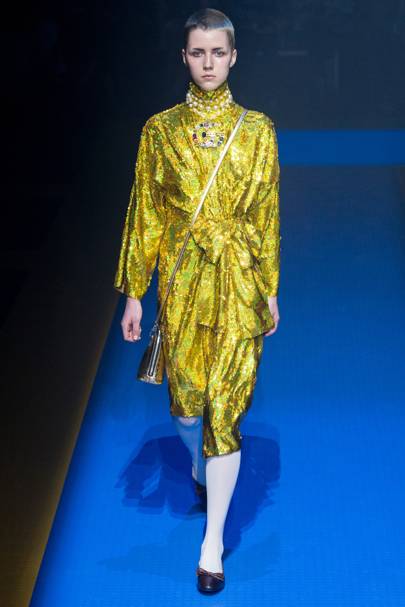
Gucci is in a collaborative mood this year. From its unexpected and brilliant union with Dapper Dan earlier this month and team-up with Angelica Hicks in May, to creative director Alessandro Michele's utilisation of Elton John's archives for his spring/summer 2018 collection (shown at Milan Fashion Week), it's proving that fashion is stronger together (its owner, Kering, even partnered with conglomerate rival LVMH recently on a model mandate, as well as Alibaba on curbing counterfeits). But it's always onwards and upwards at Gucci, and its new alliance has come courtesy of young artist Helen Downie - aka Unskilled Worker.


While the fruits of the collaboration - a 40-piece capsule collection of ready-to-wear, shoes, bags, silks and accessories - will shortly be available on October 11, its inception took place in 2015 when, after Michele discovered Downie's work on her Instagram account, he invited her to participate in Gucci’s No Longer / Not Yet art exhibition in Shanghai. As it launches, it will see a return to where it all started, as it becomes available in China at the same time as Europe, the US, Canada, the UAE, Japan, Australia and South Korea simultaneously.

The Cult Accessories Maria Grazia Chiuri Brought To Dior

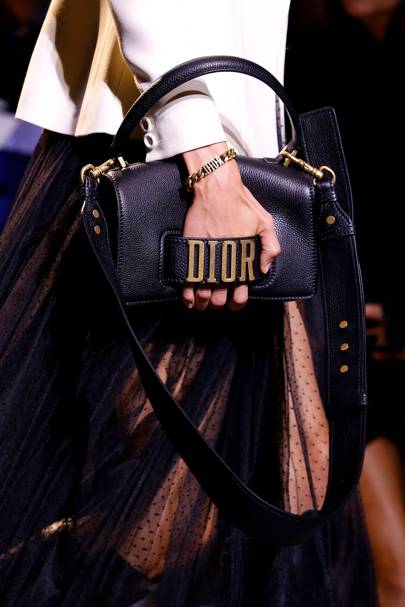
Since her appointment as artistic director of Christian Dior last summer, Maria Grazia Chiuri has been writing a new chapter in the storied house’s history. Drawing on the brand’s archives – “When I first arrived at Dior, I immediately decided to be a curator of its history,” she told Vogue exclusively before this year’s celebratory 70th anniversary exhibition – Chiuri has reinvented its aesthetic while paying homage to her predecessors. Here are the Maria Grazia Chiuri heirlooms of Dior.


The Metal Logo Bag

Her debut spring/summer 2017 collection, which drew on Dior's New Look and Chimamanda Ngozi Adichie's book We Should All Be Feminists and inspired those slogan T-shirts, saw Chiuri rework the classic brass logo, and give bags thick guitar straps, in white, black or jacquard. The brand had been looking for a handbag hit to rival the Lady Dior, and Chiuri came up with a hard-edged alternative for the dress-down generation.


The Tape Measure Heels

As soon as the logo ribboned sling-backs hit the spring/summer 2017 runway, the industry knew they would be a sell-out, just as Chiuri's rock stud shoe was at Valentino.


The Black Leather Beret

The Stephen Jones berets that all models wore on the autumn/winter 2017 catwalk gave the collection a militaristic air that would later translate into street-style gold. Rihanna and Winnie Harlow were early adopters, and the flat hat steeped in French history soon filtered down to the high street.


The Logo Saddle Bag

An early lock Chiuri loved on some luggage during one of many visits into the archives was transported onto boxy bags with those thick guitar straps in the autumn/winter 2017 collection. "I like the old logo of Dior too, something a little retro," she told Vogue after the show.

Jonathan Anderson On Cultural Consumption And Working With Steven Meisel

When Jonathan Anderson was growing up in a small town in Northern Ireland, there was one nearby newsagent that stocked international magazines – and, in 1997, aged just 13 years old, he happened to pick up a copy of Italian Vogue. It contained a photo shoot by Steven Meisel, and “it was a piece of storytelling,” he remembers now. “I’ll always remember it because of the lighting – the lighting was incredible – and so you didn’t know what country you were in, whether it was America or Britain. There was this incredible sense that the character was more important here than the fashion.”


Sixteen years later, and when Anderson decided to pitch LVMH to become the creative director of Lowee, it was that same photo shoot that opened the presentation he gave to Delphine Arnault. He had never worked with Meisel, nor even spoken to him, but “he was the person I wanted to help me with the re-brand,” he explains. “There’s not many people like him, who understand fashion like he does, who can do the full package: he could style it, do the make-up, do the hair… I don’t think I could have done this job without him; I think he was able to articulate the dream.”


It was lucky, then, that when Anderson won the pitch, Meisel got on board. Their first campaign together was actually a re-print of that archival photo shoot Anderson had seen in his childhood – and their collaboration since has been intent on pushing the boundaries of fashion advertising. It is a relationship which extends beyond the typical photographer/client dynamic, and sits at the core what Anderson is intent on achieving with Loewe. “Every single time I talk about this brand – and my own brand – I am talking about culture,” he asserts. “It’s about how do we, in the next 10 years, start to evolve culturally; how do we use fashion as a creative tool? The days of seeing fashion in isolation are over – it’s more about the idea of how you give a product value – and for me, a product’s value comes from the culture of it.”


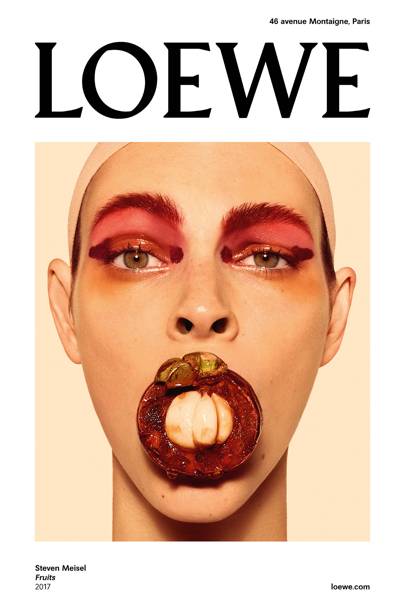
For their new campaign, Anderson and Meisel are presenting Vittoria Ceretti, remarkably made-up by Pat McGrath, in an Edenic exploration of contemporary consumption. This afternoon, one of these pictures will be distributed as the invitations to Loewe’s spring/summer 2018 fashion show, while simultaneously being plastered onto 500 Parisian news kiosks. “Each time we do a campaign, it has to challenge the entire team, and it has to be something we can put in windows, put on the street. It’s propaganda,” says Anderson. Then, on Friday, they will decorate the brand’s newly minimalist show space in the form of giant hanging tapestries.


“The collections over the past three seasons have been based upon the idea of a woman living in her own domestic space,” Anderson says. “That chapter has ended. It’s now a completely different thing, in a white, oval space. It’s about the idea of reduction.” So, amidst a stage of minimalism will stand these giant works of art, 8x4 metres apiece, each woven by specialists in the south of France using up to 40 different colours so as to resemble photographs. While these sorts of tapestries were once used to celebrate historic events or monumental achievements, now they will stand in proud celebration of this new, consumptive ideal. “Everything at the moment is propaganda,” Anderson says. “We consume what we are told to consume. Sometimes you have to reflect what is happening… and Vittoria, well, I think she really kind of consumes you. You feel like you could eat her.”

Remembrance Of Flings Past: Behind Versace's History With Supermodels

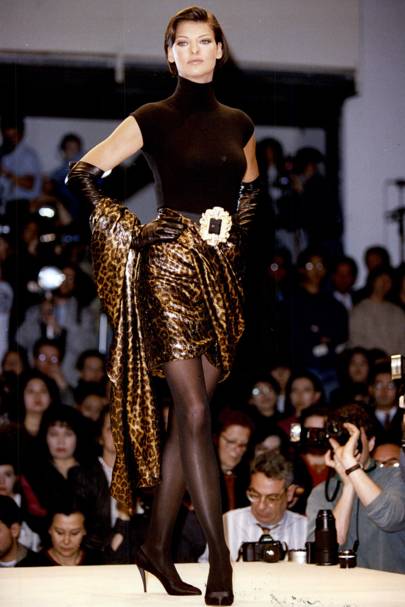
Remebrance Of Flings Past.” That’s how Richard Avedon’s book 20 Years of Versace opens - a tome which charts decades of documenting “the impassioned, shameless, opulent, titillating sewmanship of that daredevil magician of art and artifice who was and will always be Gianni Versace". It’s an apt title, because that book showcases everyone from Kate Moss to Kristen McMenamy, Naomi Campbell to Nadja Auermann; Stephanie Seymour to Stella Tennant, wearing his iconic designs. After all, there is hardly a supermodel who Versace hasn’t had a fling with, and no house whose legacy is more intertwined with the phenomenon of the super.


Once upon a time, actresses were loath to be associated with fashion, worried that to get dressed up would detract from the legitimacy of their craft. And so, as Michael Kors once said, the super was born: “Christy and Linda and Cindy and Naomi are movie stars. They’re the pin-up girls of the Nineties.” With Amazonian limbs and flawless faces, they became known by their first names only – and it was Gianni Versace who would pay the most to have them all walk his runway together. Back then, editorial models and runway models were each considered to have their own specialities, and so were confined to a specific field - but Gianni realised the power these women held and commissioned them for print campaigns and fashion shows alike.


In March 1991, Linda, Christy, Naomi and Cindy took to his stage, lip-synching to George Michael’s Freedom (they had all starred in the song’s video after Michael had seen them together, captured by Peter Lindbergh on the January 1990 cover of British Vogue), and it signified a major moment for the industry. “The Versace show wouldn’t have happened if we hadn’t done George Michael’s video, and George Michael would have chosen actresses to star in his video if he had not seen the Vogue cover,” Cindy Crawford told Vogue in 2016. “In the beginning those women were a revolution,” said Lindbergh. “They had balls, they had brains.”


It was this sensibility that made them so well-suited for the Versace world: one which was (and remains) fabulous in the truest sense of the word. The women on those runways, in those campaigns, became part of the Versace family: a hyper-glamorous dynasty which has been upheld by Donatella, perhaps the best ambassador of such an aesthetic. With this evening's show marking 20 years since Gianni’s death, and the supers making a return to the runway in his honour, we have been duly reminded that nobody shows a super like Versace.

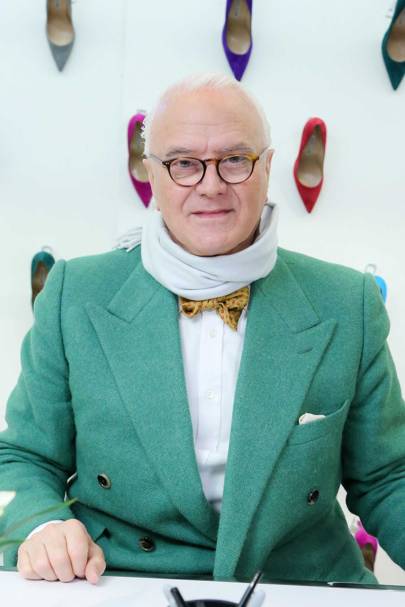
The Collaboration Manolo Blahnik Couldn't Refuse

For fans of the "high-low" look, Manolo Blahnik's collaboration with Castañer to mark the latter's 90th anniversary hits the nail on the head. Joining Blahnik's signature opulence with the espadrille connoisseurs' traditional Spanish aesthetic, the capsule collection is poised to be on every fashion aficionado’s radar when it drops at Net A Porter, Matches, Harvey Nichols and Browns Fashion in November.


Comprised of two lines - Manolo By Day and Manolo By Night, which each include three models in six different colourways and a stiletto style in lieu of an espadrille's traditional wedge - the collection is one that pleases both parties. For Castañer, it "could not better express our Mediterranean personality, our creative and stylistic richness, and our aspiration to create timeless classics which embody contemporary authenticity and luxury”, according to the family owned brand, while for Blahnik it brings his past into his present - as he told British Vogue exclusively ahead of its launch...


How did the collaboration with Castañer come about?

"It was easy. They contacted my office with a proposal to collaborate for their 90th anniversary. Being Spanish, Castañer is a company that has been there throughout my life and espadrilles are a huge part of Spain’s culture. They were everywhere when I was growing up in the Canary Islands. How could I refuse?"

What are the elements of the designs that are 100 per cent Manolo Blahnik?


"It's a Spanish product and I am a product of Spain - that’s for starters. I wanted to keep the tradition of espadrilles, but give them my touch... the colours, the fabrics, the heel. A bit of whimsy."

What are the defining features of Manolo by Day and Manolo by Night?

"For day, the materials are tougher, like canvas, and are more utilitarian. For night, I've used satin, because I love satin. That little bit of sheen makes it perfect for evening."

What is your earliest memory of the shoe style?


"We had a lady who took care of us when we were young called Maria Soccorro, who I adored. And she always wore espadrilles. I have fond memories of her, so the association is a very good one."


Why do you think collaboration is important to the fashion industry?

"If I like the collaborator, it is always more of a challenge. Sometimes bringing together two names that don’t necessarily gel together at first thought gives the most interesting results."

Is there someone that you would love to work with who you haven’t already

"At the moment, I don’t want to think about it, but if the right designer comes along, then I would be willing to collaborate."

What point are you at in your life: are you scaling back and slowing down, or raring to go?

"I am always raring to go! I can’t stop. Slowing down or scaling it down is never an option with me. It is time that is the enemy. There is never enough time."

What ambitions do you have that you are yet to fulfil?

"I don’t really care about things like that. I am not very ambitious. I consider myself to be very privileged to do what I enjoy doing. If I have one ambition now it is to keep on doing what I do better, and then to spend time with my dogs."

What do you think is the main reason for your ongoing success?


"I stick to what I believe in. I have always done so and will always do so. I don’t compromise, I don’t care about trends, I do what I want."